
How to connect AI to your tools and move past copy-paste: wiring AI into your stack with APIs and automation, Zapier vs Make vs n8n vs custom code, and what is realistic DIY vs needs a developer.
If you already use ChatGPT or Claude for real work, you have hit the ceiling of copy-paste. You open the chat, gather your inputs, paste them in, copy the answer out, and move it to wherever it needs to go. It works, but you are the wire connecting everything, and that wire is your time. The next step is learning how to connect AI to your tools so the AI runs inside your stack instead of in a separate browser tab. In this guide I will explain, in plain terms, how AI gets wired into the software you already use, the real options from no-code to custom code, and an honest split of what you can realistically do yourself versus what needs a developer.
How to connect AI to your tools: the basic idea
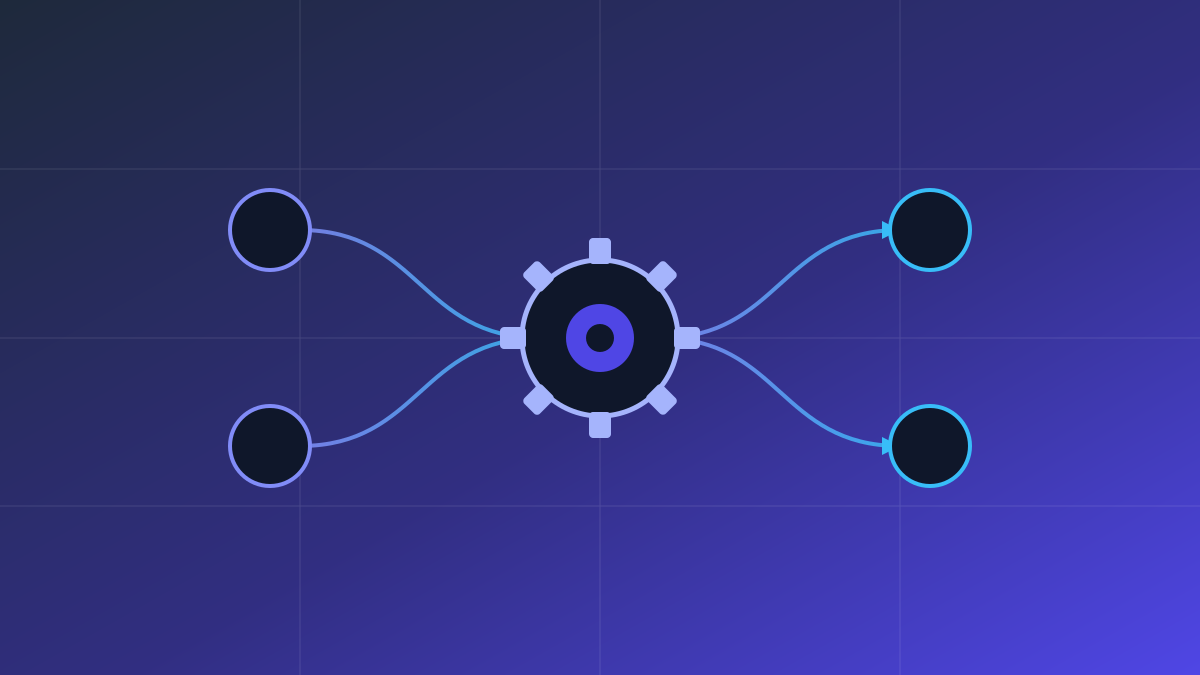
Every AI integration, no matter how fancy, is the same three-part shape. Once you see it, the whole thing stops feeling like magic.
- A trigger. Something happens that should kick off the AI: a new email arrives, a form is submitted, a row is added to a sheet, a customer sends a message.
- The AI step. Your prompt runs on that input automatically. This is the exact same instruction you would have pasted into the chat by hand, just executed by software.
- A destination. The AI's answer is delivered somewhere useful: written to your CRM, drafted as an email, posted to Slack, added to a spreadsheet.
Copy-paste is you manually playing all three roles. An integration automates the connection so the input flows to the AI and the result flows onward without you in the middle. That is the whole game. Everything else is just choosing the right tools to build those three links.
What makes it possible: APIs
The reason any of this works is the API, the application programming interface. You do not need to understand the details, just the concept: an API is a doorway that lets software talk to other software. Your AI tool has one, your CRM has one, your email and your spreadsheet have one. An integration uses those doorways to pass information automatically, the same way you would carry it by hand, but instantly and without errors.
When someone says they are "connecting AI to your CRM," what they mean is that a piece of software is using the CRM's API and the AI's API to move data between them on a trigger. You never see the APIs. You just see that a new lead now arrives in your CRM already summarized and categorized by the AI.
Your options, from easiest to most powerful
There is a real spectrum here, and the right spot on it depends entirely on your task. Here is how the main options compare.
| Option | Best for | Who can build it |
|---|---|---|
| Zapier | Simple flows, popular apps, fast setup | A non-technical owner, with patience |
| Make | More complex multi-step flows, visual logic | A comfortable DIYer or a developer |
| n8n | Self-hosted, flexible, cost-control at volume | Technical user or a developer |
| Custom code | Complex logic, high volume, full reliability | A developer |
No-code platforms (Zapier, Make, n8n)
These let you connect apps by clicking rather than coding. Zapier is the friendliest and has the most pre-built connections, great for simple, popular tools. Make gives you more visual control for multi-step logic. n8n is more technical but can be self-hosted, which keeps costs down once you run a lot of volume. For most first AI integrations, one of these is the right starting point.
Custom code
When the logic gets complex, the volume gets high, or reliability is critical, custom code talking directly to the APIs is cheaper and far more robust than stretching a no-code tool past its comfort zone. No-code platforms charge per task, so at scale the per-run fees add up, and they can get awkward when your workflow has lots of conditions and exceptions. I cover exactly where this line sits in my detailed comparison of Zapier vs custom code.
What is realistic DIY vs needs a developer
I want to be honest here rather than either overselling the tools or pretending you need to hire someone for everything. Here is the split as I actually see it.
You can realistically do yourself: a single-trigger, single-destination flow with a popular app. For example, when a form is submitted, send the answers to ChatGPT to summarize, and drop the summary into a Google Sheet. Zapier or Make can do this with patience and their templates. If your task is one clean line from A to B, try it yourself first.
You probably want a developer when: the logic branches a lot (different handling for different cases), the volume is high enough that per-task fees hurt, the data is sensitive, you are chaining several AI steps together, or the flow keeps breaking and you cannot tell why. These are the situations where a no-code build becomes a fragile tangle, and a small amount of custom code is more reliable and often cheaper over time.
My honest advice: start with a no-code attempt on your simplest task. If it works, wonderful, you saved money. If you find yourself fighting the tool, that struggle is useful information that the job has outgrown DIY. For more on telling the two apart, see business automation for small business.
Two important caveats
Before you wire AI into live systems, two things deserve real attention.
First, privacy and data. The moment AI is connected to your tools, it can touch real customer data automatically. Know what data flows where, use business-tier AI plans that exclude your data from training, and never pipe sensitive information through a service you have not vetted. An integration that leaks data is worse than no integration.
Second, accuracy and oversight. AI makes confident mistakes. When it ran in a chat, you caught those before acting. Once it is automated, nobody is watching unless you build watching in. That is why I almost always keep a human approval step for anything customer-facing, at least until the flow has proven itself on real data. Automate the work, but keep judgment in the loop where it counts.
Putting it together
Connecting AI to your tools is not a mysterious technical leap. It is the same trigger, AI step, destination you already do by hand, with the manual copy-paste replaced by APIs and an automation tool. Start by mapping the flow, pick the simplest method that fits, wire the three links, and test on real data with a human checkpoint. Do that, and the AI you have been pasting into a chat starts working quietly inside your business instead.
If you have a copy-paste habit you would like to wire into your actual tools, that is exactly the kind of project I build. Book a call and walk me through the manual version, and I will tell you whether it is a clean DIY job or worth having me build it properly. You can also reach me through the contact form, or read more about AI agents for business automation if you want to see where this can lead.
Frequently asked questions
How do you connect AI to business tools like a CRM?
Through APIs and an automation layer. Every integration follows the same shape: a trigger (a new email, form, or row), an AI step that runs your prompt automatically, and a destination where the result lands, such as your CRM. An automation tool or custom code uses the APIs of your AI service and your CRM to pass the data between them without any copy-paste.
Do I need to know how to code to connect AI to my tools?
Not for simple flows. A single-trigger, single-destination workflow using a popular app can often be built in a no-code platform like Zapier or Make with patience and their templates. You move toward needing a developer when the logic branches a lot, the volume is high, the data is sensitive, or you are chaining several AI steps together.
What is the difference between Zapier, Make, n8n, and custom code?
Zapier is the friendliest no-code option with the most pre-built connections, ideal for simple flows. Make gives more visual control for multi-step logic. n8n is more technical but self-hostable, which controls cost at high volume. Custom code talks directly to the APIs and is best when logic is complex, volume is high, or reliability is critical.
Is it safe to connect AI directly to my customer data?
It can be, if you are careful. Once AI is connected, it touches real data automatically, so know exactly what data flows where, use business-tier AI plans that exclude your data from training, and never route sensitive information through a service you have not vetted. For customer-facing output, keep a human approval step until the flow has proven itself.
What is an API in simple terms?
An API is a doorway that lets one piece of software talk to another. Your AI tool, your CRM, your email, and your spreadsheet each have one. An AI integration uses these doorways to pass information between them automatically, the same way you would carry it by hand, but instantly and without copy-paste errors. You never see the API, only the result.
Keep reading
Related service
Integrations
Make the systems you already pay for talk to each other.
About the author
Yehonatan Saadia
Freelance automation, web & MVP developer
I'm Yehonatan Saadia, a senior developer who builds business automation, custom websites, and MVPs for small and mid-sized companies across the US, Europe, and Israel. These guides come from real client work, not theory.
Work with meHave a project like this?
Tell me what you're trying to automate or build and I'll tell you the fastest reliable way to ship it.