
n8n for beginners: what n8n is, cloud vs self-hosted, and a step-by-step walkthrough to build your first trigger-to-action workflow - plus honest tips on its limits.
If you are just starting with automation and looking at n8n, you have picked a good first tool. n8n for beginners is friendlier than it looks: it is a visual workflow builder where you connect boxes called nodes to make different apps talk to each other automatically, with no code required for most simple tasks. In this guide I will explain what n8n actually is, walk you through the one decision that trips up newcomers (cloud versus self-hosting), build your first workflow with you step by step, and share honest tips on getting it right and knowing its limits. I use n8n with clients regularly, so this is the practical version, not the marketing one.
n8n for beginners: what n8n actually is
n8n is a workflow automation tool. The simplest way to picture it: you have apps that do not talk to each other - your email, a spreadsheet, a chat tool, a CRM - and n8n is the wiring that connects them so that when something happens in one, something automatically happens in another. A new form submission lands a row in a spreadsheet. A new sale fires a Slack notification. A daily schedule pulls data and emails you a summary.
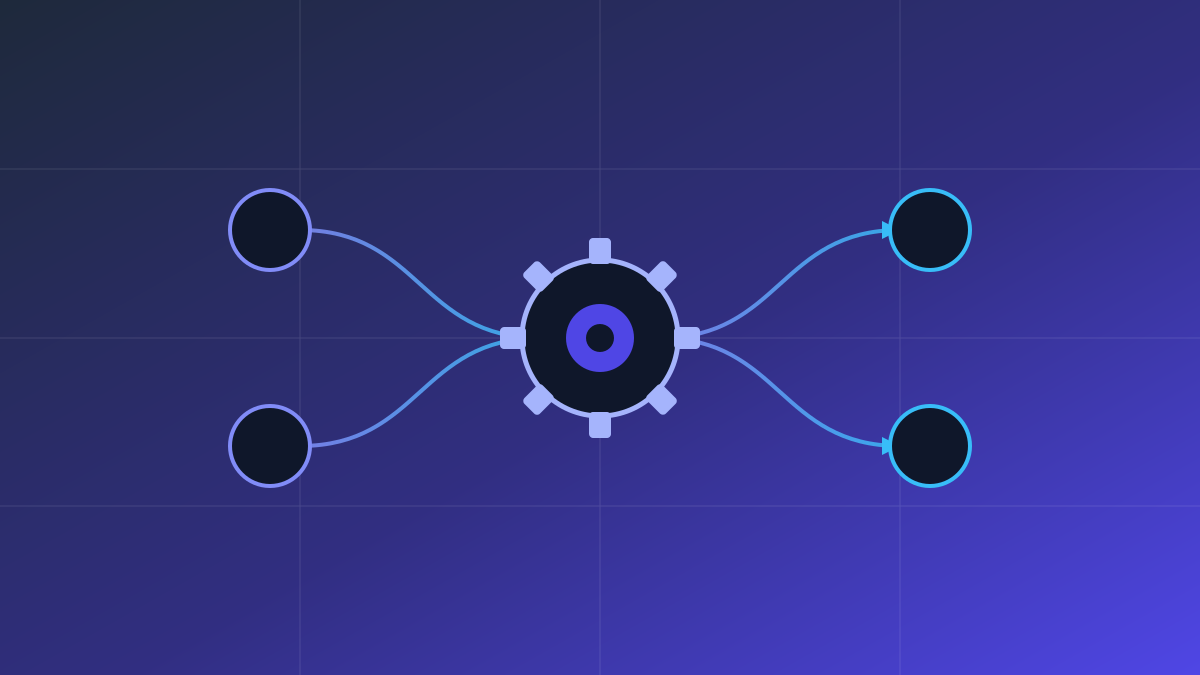
You build this on a visual canvas. Each step is a node, and you connect nodes with lines so data flows from one to the next. A workflow is just a chain of nodes: a trigger that starts it, then one or more actions that do the work. That is the entire mental model, and once it clicks, most simple automations are obvious. n8n has hundreds of pre-built nodes for popular apps, so connecting common tools is usually a matter of picking them from a list.
What sets n8n apart from other beginner tools is that it does not box you in. When a visual node cannot do exactly what you need, you can drop into a Code node and write a little JavaScript or Python. You will not need that on day one, but it is nice to know the ceiling is high.
Cloud vs self-hosted: the one decision to make first
This is where beginners get stuck, so let me make it simple. n8n offers two ways to run it, and the right choice depends entirely on where you are in your journey.
| Aspect | n8n Cloud | Self-hosted |
|---|---|---|
| Setup | Sign up and start - nothing to install | You install and configure it on a server |
| Maintenance | n8n handles updates and uptime | You patch, back up, and monitor it |
| Cost | A monthly subscription | Free software, but you pay for the server and your time |
| Data control | Runs on n8n's infrastructure | Your data stays on your own server |
| Best for | Beginners and most small teams | Privacy-sensitive or high-volume needs |
My honest advice for a beginner: start with n8n Cloud or a quick local install. The whole point right now is to learn how workflows work, and you do not want to spend your first week being a server administrator instead. Self-hosting is genuinely valuable - it keeps your data on your own infrastructure and avoids per-seat pricing - but it turns the "no-code" promise into "you now run infrastructure," which is a step to take later, once you know you need it. When you do, I wrote a full n8n self-hosting guide for exactly that moment.
Building your first workflow, step by step
Let me walk you through the shape of a first workflow. I will keep it concrete with a simple example: when a new row is added to a Google Sheet, send yourself a Slack message. The exact apps do not matter - this trigger-to-action pattern is the foundation of everything you will build.
1. Open the editor
Once you are in n8n, you get a blank canvas. This is where you drag and connect nodes. Do not be intimidated by the empty space - your first workflow will only have two nodes.
2. Add a trigger node
Every workflow starts with a trigger, the event that sets it running. Click to add a node and choose a trigger. Common ones are a schedule (run every hour), a webhook (run when data arrives at a URL), or an app event (run when a new row appears in your sheet). The trigger is the answer to "when should this run?"
3. Add an action node and connect it
Now add a second node that does something - the Slack node to send a message. Drag a connecting line from the trigger to this action so data flows between them. You now have the complete skeleton: something happens, then something else happens because of it.
4. Map the data
Tell the Slack node what to say, pulling fields from the trigger's data. n8n shows you the incoming data, so you can drag the relevant fields into the message - for example, the name from the new row. Getting this mapping right is the part that makes beginners feel like it finally works.
5. Test it
Run the workflow manually and look at the output of each node. Did the trigger pull the right data? Did the message actually send? Inspect each step. Never trust a workflow you have not watched run at least once.
6. Activate and add a safety net
Flip the workflow to active so the trigger runs on its own, then add a basic error notification so you find out if a run fails. A silent failure is the worst kind, because you keep believing the automation is working when it stopped days ago.
Beginner tips that save you pain
A few things I wish every beginner knew before they started:
- Start tiny. Your first workflow should be two nodes, not twenty. Master trigger-to-action before you chain ten steps together.
- Test at every node. Do not build the whole thing and run it once at the end. Add a node, test, add the next, test. It is far easier to find a problem in two nodes than in twenty.
- Name your nodes. "HTTP Request1" tells you nothing in three months. Rename nodes to what they do.
- Watch out for silent failures. Always add error handling on anything you depend on. An automation you cannot tell is broken is a liability.
- Do not over-automate early. Automate one painful, repetitive task first and let it prove itself before you build an empire of workflows.
If you are weighing n8n against other beginner-friendly tools, I compare the landscape in Zapier alternatives for small business.
Knowing the limits: when to graduate beyond n8n
I want to be honest, because pretending n8n does everything would not help you. It is excellent for gluing well-supported apps together with light logic, and for that it is fast and a joy to use. But it has a ceiling. As a workflow grows complex, the visual canvas becomes hard to read, you cannot write proper automated tests for a node graph, and reviewing changes gets awkward. When you find yourself stuffing significant logic into Code nodes or worrying whether a critical flow will hold under load, that is the signal it has outgrown the tool. I cover exactly where that line sits in n8n vs custom code.
For a beginner, though, none of that should stop you. Start simple, learn the trigger-to-action pattern, and you will be automating real work within an afternoon.
The bottom line
n8n is one of the best places to start with automation. It is a visual tool where you connect nodes - a trigger plus one or more actions - to make your apps work together. Begin on n8n Cloud or a local install so you can learn without becoming a server admin, build your first two-node workflow, test it at every step, and add a safety net before you trust it. Keep it small, automate one painful task first, and graduate to self-hosting or custom code only when you genuinely outgrow the simple path.
If you would rather skip the learning curve, or you have a workflow that is already too complex for a visual tool, that is exactly the kind of thing I build for clients - and I set it up and host it so you do not have to manage the infrastructure. Book a call and tell me what you want automated, or reach me through the contact form, and I will tell you honestly whether n8n is the right tool for the job or whether you need something sturdier.
Frequently asked questions
What is n8n in simple terms?
n8n is a visual workflow automation tool. You connect boxes called nodes on a canvas to make your apps talk to each other automatically - for example, a new form submission adds a row to a spreadsheet, or a new sale sends a Slack message. Every workflow is a trigger that starts it plus one or more actions, and most simple tasks need no code.
Should a beginner use n8n Cloud or self-host it?
Beginners should start with n8n Cloud or a quick local install. The goal early on is to learn how workflows work, and self-hosting turns the no-code promise into running infrastructure - patching, backups, and monitoring. Self-hosting is genuinely valuable for data control and high volume, but it is a step to take later, once you know you need it.
What is a trigger and an action in n8n?
A trigger is the event that starts a workflow - a schedule, a webhook, or an app event like a new email or form submission. An action is a node that does something with that data, like sending a message or adding a spreadsheet row. Connecting a trigger to an action is the core pattern of every n8n workflow.
Do I need to know how to code to use n8n?
No, not for most simple workflows. n8n has hundreds of pre-built nodes, so connecting common apps is mostly picking them from a list and mapping fields. If you later need something a node cannot do, you can drop into a Code node and write a little JavaScript or Python, but you will not need that to build your first workflows.
When should I move from n8n to something more powerful?
Move on when a workflow grows complex, becomes business-critical, or runs at high volume, or when you find yourself stuffing significant logic into Code nodes. The signs are a canvas that is hard to read, no way to write proper tests, and worry about whether the flow holds under load. At that point a custom-built service is cleaner and more reliable.
Keep reading
Related service
Business Automation
I build custom automations that remove repetitive work end to end.
About the author
Yehonatan Saadia
Freelance automation, web & MVP developer
I'm Yehonatan Saadia, a senior developer who builds business automation, custom websites, and MVPs for small and mid-sized companies across the US, Europe, and Israel. These guides come from real client work, not theory.
Work with meHave a project like this?
Tell me what you're trying to automate or build and I'll tell you the fastest reliable way to ship it.