
What is an API integration? A plain-English guide: how connecting two software systems so they share data automatically works, real business examples, costs, and when you need one.
An API integration is when two separate software systems are connected so they can share data and trigger actions automatically, without a person copying anything between them. If your online store automatically tells your accounting software about every new sale, that is an API integration at work. In plain terms: it is the wiring that lets your tools talk to each other, so information flows on its own instead of someone retyping it from one screen to the next.
Almost every business runs a stack of separate apps - a store, a CRM, accounting, email, a spreadsheet - and the gaps between them are where hours quietly leak. In this guide I will explain what an API integration is without jargon, how it works, why it matters to your bottom line, real examples, what it costs, and when you actually need one. I will be honest about the limits too.
What is an API integration, in plain English
First, the building block. An API is the doorway a piece of software offers so other software can talk to it - a defined set of requests it understands and answers. I cover it fully in my guide to what an API is. An API integration is what you build on top of that: the actual connection where one system uses another's API to send or fetch data, on a schedule or whenever something happens.
The everyday analogy: an API is a power socket on the wall, and an integration is the appliance you plug in and the job it does. The socket sitting there does nothing on its own. The integration is the working connection that makes the lights come on - that turns "this tool can be connected" into "these two tools now work together."
How an API integration works
Strip away the jargon and an integration is a simple cause-and-effect chain.
- A trigger happens. Something occurs in one system - a new order, a form submitted, a deal marked won, a set time of day arrives.
- Data is sent or fetched. The integration calls the other system's API: "here is the new customer, add them," or "give me today's orders."
- The other system responds. It does the work - creates the record, returns the data - and confirms the result.
- An action follows. The data lands where it needs to be, and often kicks off the next step: a confirmation email, an updated dashboard, a task created.
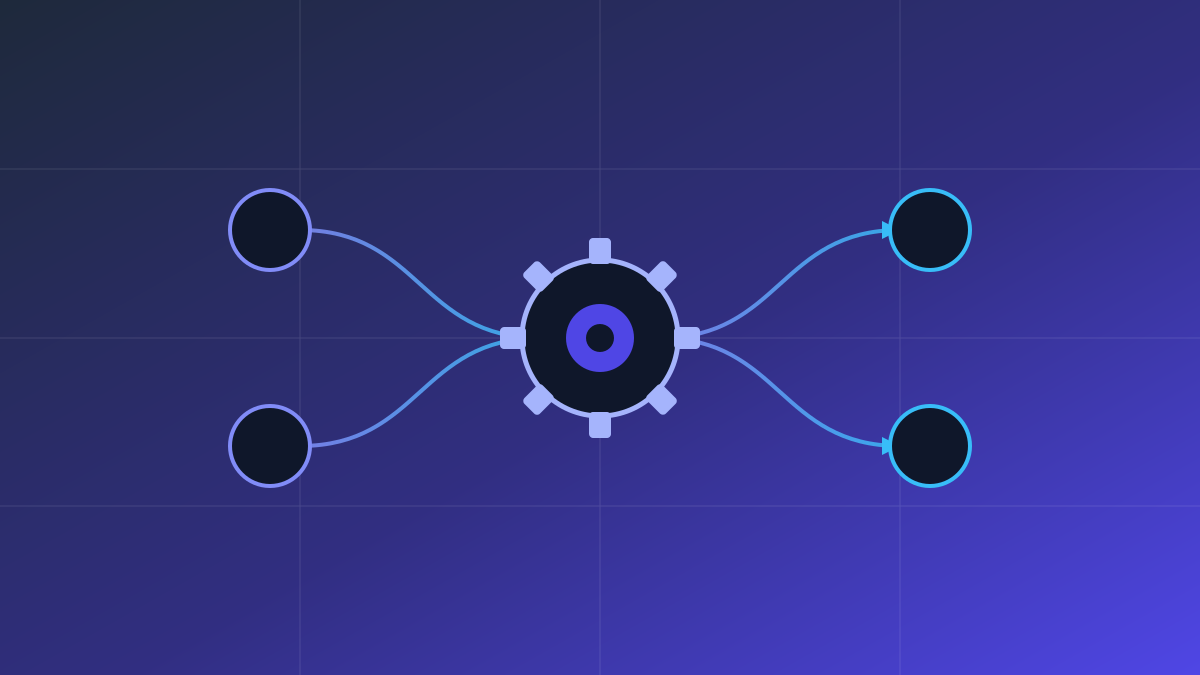
That chain can be one simple hop between two apps, or a longer flow stitching several systems together. The principle is the same: a trigger in one place causes data and actions to flow automatically to another, with no human in the middle. When you connect several of these into a working process, you have crossed into full business automation.
Why API integration matters for your business
The payoff is concrete and easy to feel, because the pain it removes is one you probably live with.
- It kills double data entry. The single biggest win. No more typing the same customer, order, or invoice into two or three systems. Enter it once; it appears everywhere.
- It removes copy-paste errors. Humans mistype, transpose digits, and forget steps. A correct integration moves data the same way every time, so your numbers stop drifting between systems.
- It works around the clock. Integrations do not wait for someone to be at their desk. An order at 2am updates inventory and notifies you immediately, not the next morning.
- It gives you one source of truth. When systems sync, your CRM, accounting, and store agree. Decisions stop being guesses based on stale, conflicting numbers.
- It frees your team for real work. Hours spent shuttling data between tools are hours not spent serving customers or growing the business.
Real API integration examples
Here is what businesses actually connect, day to day.
| From | To | What it does |
|---|---|---|
| Online store | Accounting software | Every sale becomes an invoice automatically |
| Website form | CRM | New leads land in your pipeline instantly |
| Payment processor | Spreadsheet / dashboard | Revenue updates in real time |
| CRM | Email tool | A won deal triggers a welcome sequence |
| Booking system | Calendar | Confirmed bookings appear as events |
Notice the pattern: every one of these replaces a recurring manual chore - a person who would otherwise be re-entering the same information by hand, several times a day. That repetitive, error-prone shuttling is exactly what integration is built to remove.
What does an API integration cost?
This is the question owners actually want answered, so let me be direct. Cost depends almost entirely on two things: how well the systems support being connected, and how complex the flow is.
- Simple, well-documented systems - popular store, CRM, and accounting tools with solid, modern APIs - are the cheapest to connect. A clean two-system integration is often a small, fast project.
- Custom or older systems - in-house software, legacy tools, anything with a weak or undocumented API - cost more, because the connection has to be carefully built and tested rather than wired up from known parts.
- Complex flows - many systems, conditional logic, large volumes, careful error handling - naturally cost more than a single hop.
There is also a no-code middle road: tools that connect popular apps without custom development. They are great for standard flows and a poor fit when the logic gets specific or the volume gets serious - that is the line where a properly built integration pays off. For the full breakdown of how automation work is priced, see my guide to how much business automation costs.
The limits you need to know
Integrations are some of the highest-return work I do, but they are not set-and-forget magic.
- They need maintenance. When a connected app changes its API, the integration can break. A good one is monitored and fixed quickly; an unwatched one fails silently, which is worse.
- They depend on the systems' APIs. If a tool offers no API or a poor one, your options narrow. Sometimes the honest answer is that a clean integration is not possible with the tools you have.
- They move bad data faithfully. An integration does not clean your data - it copies whatever it is given. Messy inputs become messy outputs, faster.
- They need error handling. What happens when the other system is down or rejects a record? A serious integration plans for failure so nothing is lost; a quick hack does not.
When do you need an API integration?
The signal is simple and you already feel it: you or your team are regularly copying the same data from one system into another. Every recurring manual transfer is a candidate. If you re-enter orders into accounting, retype leads into a CRM, or keep a spreadsheet in sync by hand, an integration almost certainly pays for itself quickly.
You probably do not need one yet if the transfer happens rarely, the volume is tiny, or the systems involved genuinely have no usable API. The rule of thumb I give clients: if a task is repetitive, predictable, and moving data between systems, it is a strong integration candidate - and these are some of the fastest wins in all of automation.
If you are tired of copying data between your tools and want to know what it would take to connect them, book a call and tell me which systems you use. I will tell you honestly whether a clean integration is possible, roughly what it would cost, and where the biggest time savings are. You can also reach me through the contact form.
Frequently asked questions
What is an API integration in simple terms?
An API integration is a connection between two software systems that lets them share data and trigger actions automatically, with no person copying anything between them. For example, when a new sale in your online store automatically becomes an invoice in your accounting software, that is an API integration doing the work.
What is the difference between an API and an API integration?
An API is the doorway a system offers so other software can talk to it - the defined set of requests it understands. An API integration is the working connection you build on top of that, where one system actually uses another's API to send or fetch data. Think of the API as a power socket and the integration as the appliance plugged into it doing a real job.
How much does an API integration cost?
It depends on how well the systems support being connected and how complex the flow is. Popular tools with solid modern APIs and a simple two-system flow are the cheapest and fastest. Custom or older systems, weak APIs, or complex multi-system logic cost more. No-code connectors cover standard flows cheaply but fall short when the logic gets specific or the volume gets serious.
Do API integrations break or need maintenance?
Yes. When a connected app changes its API, an integration can break, so it needs monitoring and quick fixes. A well-built integration is watched and recovers gracefully from failures; an unwatched one can fail silently and lose data, which is worse. Maintenance is a real and ongoing part of owning integrations, not a one-time cost.
When do I need an API integration?
When you or your team regularly copy the same data from one system into another. If you re-enter orders into accounting, retype leads into a CRM, or keep a spreadsheet in sync by hand, an integration almost certainly pays for itself quickly. You probably do not need one if the transfer is rare, the volume is tiny, or the systems genuinely have no usable API.
Keep reading
Related service
Integrations
Make the systems you already pay for talk to each other.
About the author
Yehonatan Saadia
Freelance automation, web & MVP developer
I'm Yehonatan Saadia, a senior developer who builds business automation, custom websites, and MVPs for small and mid-sized companies across the US, Europe, and Israel. These guides come from real client work, not theory.
Work with meHave a project like this?
Tell me what you're trying to automate or build and I'll tell you the fastest reliable way to ship it.