
What is no-code? A plain-English guide: how no-code lets you build apps, sites, and automations without programming, how it differs from low-code and custom code, real examples, and its honest limits.
No-code is a way to build software - websites, apps, automations, internal tools - using visual drag-and-drop interfaces instead of writing programming code. Rather than typing instructions in a programming language, you assemble your tool from ready-made building blocks, configure them by clicking and filling in forms, and the platform turns that into a working product behind the scenes. It is what lets a business owner with no technical background launch a website, wire two apps together, or build a customer database without hiring a developer for every small thing.
No-code is one of the most useful and most over-promised ideas in the business software world right now. In this guide I will define what no-code really is, explain how it works, show how it compares to low-code and to custom development, give real examples, and be honest about where it shines and where it quietly falls apart - because knowing the limits is what saves you money.
What is no-code, in plain English
Think about the difference between cooking from a recipe written in raw chemistry versus assembling a meal from pre-prepared ingredients you just combine. Traditional software development is closer to the chemistry: a developer writes precise instructions in code, line by line. No-code is the pre-prepared ingredients: the hard parts are already built, and you just arrange and connect them visually.
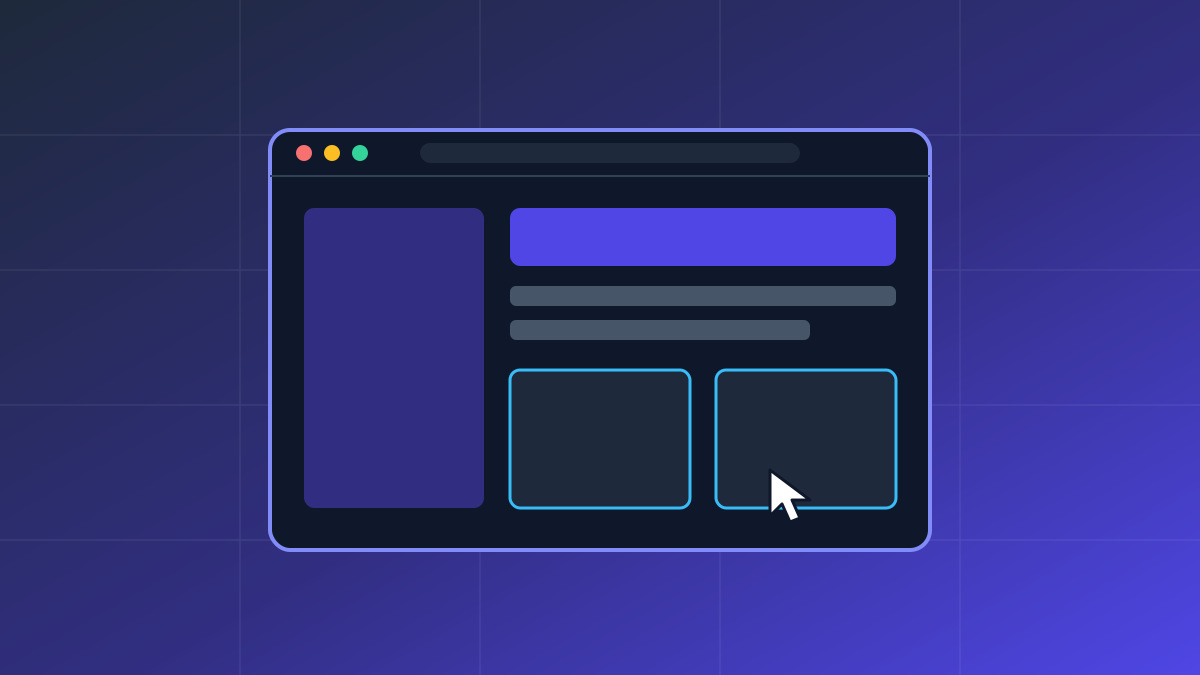
In practice, a no-code platform gives you a canvas and a set of components - buttons, forms, lists, database tables, payment blocks - that you drag into place and configure with menus and toggles. You are still building something real and making genuine decisions about how it works; you are simply not writing the underlying code by hand. The platform generates and runs that for you.
The promise is straightforward: faster builds, lower cost, and the ability for non-technical people to create working tools themselves. For a wide range of common business needs, that promise genuinely holds.
How no-code works
Most no-code platforms share the same basic approach, whether you are building a website, an app, or an automation:
- Visual building blocks. You drag pre-made components onto a canvas - a page section, a form, a database view - instead of coding them.
- Configuration over coding. You set behavior through menus, toggles, and form fields: "when this button is clicked, save the form and send an email."
- Built-in data and logic. The platform handles storing your data, user logins, and basic logic so you do not have to build that foundation.
- Connections to other tools. Most no-code tools can link to your other apps, often through ready-made integrations or via an API when you need a custom connection.
A big slice of the no-code world is specifically about automation - connecting the tools you already use so data flows between them without manual copying. That is one of the highest-value, lowest-risk uses of no-code, and a great place to start; my guide to automating Google Sheets is a concrete example of exactly this.
No-code vs low-code vs custom code
These three terms get used loosely, so here is the clean comparison. They are a spectrum, not rivals - the right choice depends on how custom and complex your need is.
| Approach | Who builds it | Best for |
|---|---|---|
| No-code | Anyone, visually, no programming | Common needs: sites, forms, simple apps, automations |
| Low-code | Mostly visual, with small bits of code for the tricky parts | More custom logic while keeping speed |
| Custom code | A developer, writing everything from scratch | Unique, complex, or large-scale products |
No-code means zero programming - you stay entirely within the visual tools. Low-code is mostly visual but lets a developer drop in a little custom code where the platform's blocks are not enough, giving you more flexibility. Custom code is fully hand-built, which is the most flexible and powerful but also the slowest and most expensive. Most businesses end up using a mix: no-code for the standard parts and custom code only where the business genuinely needs something the platforms cannot do.
Real no-code examples for business
Here is where no-code earns its reputation. These are things I regularly see businesses build themselves or with light help, fast and affordably:
- A marketing website or landing page. Site builders let you launch a professional site by dragging sections and editing text - no developer needed for most cases.
- Internal tools and databases. A customer tracker, an inventory list, or a simple project board built on a no-code database, replacing a messy spreadsheet.
- Automations between apps. When a form is submitted, add the lead to your CRM, notify the team, and start a follow-up - all wired visually. This is often paired with an AI agent for the steps that need judgment.
- Forms and intake flows. Booking forms, application forms, and surveys that feed straight into your systems.
- A simple app or member portal. A basic mobile or web app for a focused purpose, built without a full development team.
The common thread: these are common needs that many businesses share, which is exactly why ready-made building blocks exist for them.
The honest limits of no-code
This is the part the hype skips, and it is the part that protects your budget. No-code is excellent, but it is not magic, and the failures I see usually come from pushing it past where it fits.
- Complex or unique logic hits a ceiling. The moment your need goes beyond what the platform's blocks support, you either contort the tool painfully or you are stuck. Truly custom workflows often need custom code.
- You are renting, not owning. Your tool lives on someone else's platform, with their pricing, their limits, and their rules. If they raise prices or shut a feature, you adapt.
- Costs can creep. No-code is cheap to start, but monthly fees per user, per record, or per action can add up as you grow - sometimes past what a one-time custom build would have cost.
- Performance and scale have limits. For very high volume or demanding workloads, no-code platforms can struggle where purpose-built code would not.
- Lock-in is real. Moving off a no-code platform later can be hard, because your logic and data are tied to that specific tool.
None of this makes no-code a bad choice. It makes it a situational choice. The skill is knowing when a no-code build will serve you for years and when it is a trap you will pay to escape later.
When to use no-code - and when not to
Here is the practical test I use with clients. Reach for no-code when your need is common rather than unique, you want to launch quickly and cheaply, the volume is modest, and being on someone else's platform is an acceptable trade. Most websites, internal trackers, forms, and tool-to-tool automations fit this perfectly.
Reach for custom code (or low-code) when your logic is genuinely unique to your business, you need full control and ownership, you are operating at serious scale, or the thing you are building is your product and your competitive edge. In those cases, paying for custom work up front is usually cheaper than fighting a no-code platform forever.
The smartest approach is often a blend: build the standard 80% with no-code to move fast and save money, and invest in custom code only for the 20% that genuinely needs it. I cover how this trade-off plays out in real budgets in my guide to how much business automation costs.
Related terms you will hear
- Low-code - mostly visual building, with small amounts of custom code for the tricky parts.
- Drag-and-drop - the visual way you assemble components in no-code tools.
- Integration - connecting your no-code tool to your other apps.
- Lock-in - being tied to one platform, making it hard to move later.
Where to start
If you have a clear, common need - a website, a better internal tracker, or two apps that should talk to each other - no-code is very likely the fastest, cheapest way to get there, and often something you can drive yourself. The trick is choosing the right tool and not over-building on a platform that will fight you later.
If you are not sure whether your idea is a clean no-code fit or one of those cases that quietly needs custom code, book a call and describe what you want to build. I will tell you honestly whether no-code, low-code, custom code, or a blend is the right path - and roughly what each would cost. You can also reach me through the contact form.
Frequently asked questions
What is no-code in simple terms?
No-code is a way to build software - websites, apps, automations, internal tools - using visual drag-and-drop interfaces instead of writing programming code. You assemble your tool from ready-made building blocks and configure them by clicking and filling in forms, and the platform turns that into a working product behind the scenes. It lets non-technical people build real tools without a developer.
What is the difference between no-code and low-code?
No-code means zero programming - you stay entirely within visual tools. Low-code is mostly visual but lets a developer drop in small bits of custom code where the platform's blocks are not enough, giving you more flexibility for tricky logic. No-code is faster and accessible to anyone; low-code adds power for cases that need a little more than the standard blocks offer.
What are the limits of no-code?
No-code hits a ceiling on complex or unique logic, you are renting on someone else's platform with their pricing and rules, monthly fees can creep up as you grow, performance has limits at very high volume, and moving off a platform later can be hard because of lock-in. None of this makes no-code bad - it makes it situational. The skill is knowing when it will serve you for years and when it is a trap.
When should I use no-code instead of custom code?
Use no-code when your need is common rather than unique, you want to launch quickly and cheaply, the volume is modest, and being on someone else's platform is acceptable - most websites, internal trackers, forms, and tool-to-tool automations fit perfectly. Use custom code when your logic is genuinely unique, you need full control and ownership, you are at serious scale, or the thing you are building is your product.
Can I mix no-code and custom code?
Yes, and it is often the smartest approach. Build the standard 80% with no-code to move fast and save money, and invest in custom code only for the 20% that genuinely needs it - the unique logic, the heavy scale, or the part that is your competitive edge. This blend gives you speed and affordability where you can have it, and full control where it actually matters.
Keep reading
Related service
Web Development
Fast, custom websites and web apps you fully own.
About the author
Yehonatan Saadia
Freelance automation, web & MVP developer
I'm Yehonatan Saadia, a senior developer who builds business automation, custom websites, and MVPs for small and mid-sized companies across the US, Europe, and Israel. These guides come from real client work, not theory.
Work with meHave a project like this?
Tell me what you're trying to automate or build and I'll tell you the fastest reliable way to ship it.