
What is workflow automation? A plain-English guide: how it works, real business examples, the steps to automate a process, where it pays off, and where it does not.
Workflow automation is software that does a repetitive business process for you - automatically, on a trigger, following the same steps every time, without anyone touching it. Instead of a person copying data between apps, sending the same follow-up email, or moving a file from A to B by hand, the workflow runs itself the moment something happens. The simplest way to picture it: you write down the steps you do over and over, and then a tool does exactly those steps for you, every time, in seconds, while you do something more valuable.
This is the quiet workhorse behind most of the time savings small businesses get from technology - far more common and more reliable than the flashier AI tools. In this guide I will explain what workflow automation really is in plain terms, show how it works, give real business examples, walk through the steps to automate a process, and be honest about where it pays off and where it does not.
What is workflow automation, in plain English
A workflow is just a sequence of steps you take to get something done: a lead comes in, you add it to your list, you send a welcome email, you create a task to follow up. Right now a person does each step by hand. Workflow automation means handing that exact sequence to software so it runs on its own.
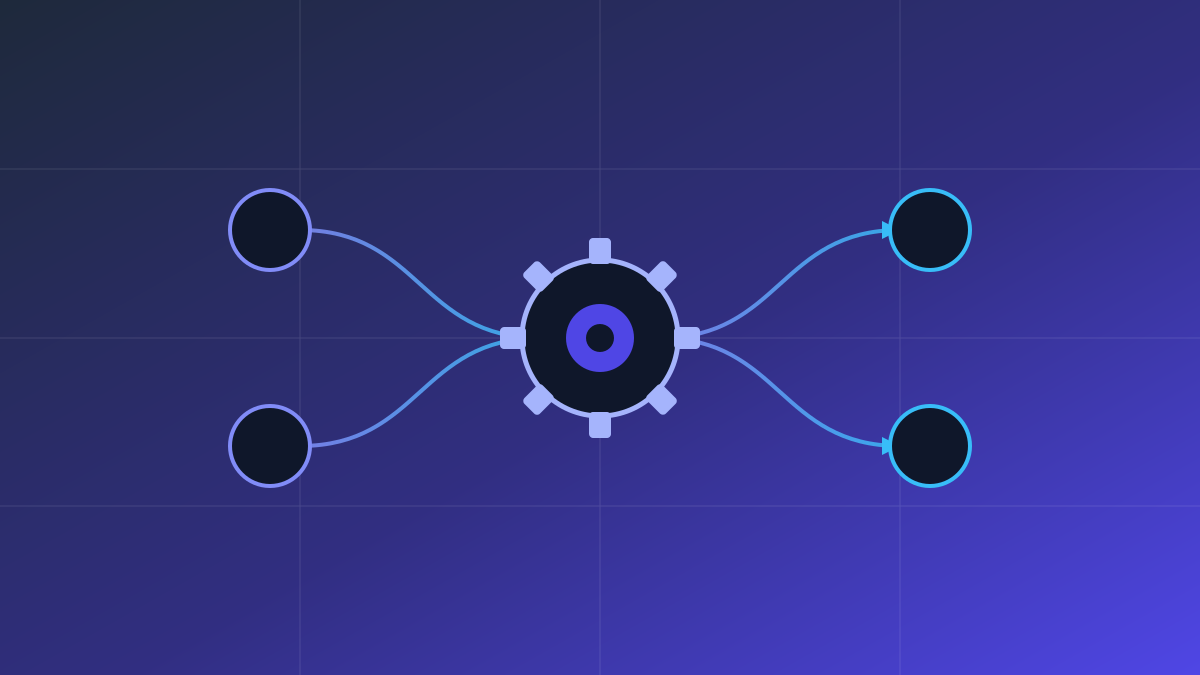
Every automated workflow has the same three parts, and once you see them you will spot automation opportunities everywhere:
- A trigger - the event that starts it. A form is submitted, an email arrives, an order is placed, a date is reached.
- Actions - the steps that follow. Add a row to a spreadsheet, send an email, create a task, update a record, post a notification.
- Logic - the rules that decide what happens. If the order is over a certain amount, notify the manager; otherwise, just file it.
That is the whole model: when this happens, do these steps, following these rules. It is predictable and repeatable on purpose - that is its strength.
How workflow automation works
The magic is mostly connection. Your business already runs on a handful of tools - your email, your spreadsheet or CRM, your invoicing app, your calendar. The problem is that they do not talk to each other, so you become the glue, carrying data between them by hand. Workflow automation is the software that connects those tools and moves the data for you.
Behind the scenes, apps talk to each other through an API - the technical doorway that lets one program send data to another. You do not need to understand the plumbing; the point is that when your form tool and your CRM both have an API, an automation can take a new submission from one and create a record in the other automatically. No copy-paste, no missed entries, no delay.
Some workflows run on no-code platforms you configure by clicking; others are custom-built when the process is complex or the volume is high. Either way, the result is the same: a process that used to need a human now runs by itself and does not get tired, distracted, or forgetful.
Real workflow automation examples
Concrete examples make this land. Here is what workflow automation realistically does for small and mid-sized businesses every day.
| Trigger | Automated workflow |
|---|---|
| A contact form is submitted | Add the lead to your CRM, send a welcome email, create a follow-up task, and notify you in chat |
| An invoice goes unpaid for 7 days | Send a polite reminder email automatically, then escalate if still unpaid after 14 |
| A new order is placed | Update inventory, generate a packing slip, and email the customer a confirmation |
| A meeting is booked | Add it to your calendar, send a confirmation with a video link, and schedule a reminder |
| A spreadsheet row is added | Validate the data, format it, and push it into your main system of record |
Notice the common thread: every one of these is a process you already do, that follows the same steps every time, and that no longer needs your attention once it is set up. That is the sweet spot. For a wider tour of where this saves the most time, see my guide to how much business automation costs.
How to automate a workflow: the steps
You do not automate everything at once. Here is the order I follow with clients, and it is worth knowing even if you hire someone to build it.
- Pick one painful, repetitive process. Start with something you do often, by hand, that follows clear steps - the kind of task you dread. High frequency plus clear rules equals a great first candidate.
- Write the steps down exactly. List the trigger, every action, and every rule. If you cannot describe it precisely, it is not ready to automate yet - this step alone often reveals where the real mess is.
- Connect the tools. Identify which apps are involved and confirm they can talk to each other. This is where the API matters.
- Build, then test on real cases. Run it on real examples and watch for the edge cases - the weird inputs that break a rigid flow. Good automation handles these gracefully or routes them to a human.
- Monitor and improve. Watch it for a few weeks, fix what surprises you, then automate the next process. Automation is a habit, not a one-off.
Where workflow automation pays off - and where it does not
I would not be doing my job if I oversold this. Workflow automation is powerful, but it is the right tool only in specific conditions.
It pays off when the task is high-frequency, follows clear and stable rules, spans multiple tools that should be connected, and is currently eating real hours of someone's week. The more repetitive and predictable the work, the bigger the win - and the more reliable the result, because software does not make the careless mistakes a tired human does.
It does not pay off when the process changes constantly, happens rarely, or genuinely needs human judgment at every step. Automating a one-off task costs more to set up than it ever saves. And when a step needs real judgment on messy input, that is where AI tools come in - I cover that line in my guide to what an AI agent is. The honest rule: automate the predictable, keep humans for the judgment, and combine the two when a process needs both.
If you have a repetitive process eating your week and you are not sure whether it is a good fit, book a call and describe it. I will tell you honestly whether automation is worth it, roughly what it would take, and where to start. You can also reach me through the contact form.
Frequently asked questions
What is workflow automation in simple terms?
Workflow automation is software that runs a repetitive business process for you automatically. You write down the steps you normally do by hand - like adding a lead to your CRM and sending a welcome email - and the tool does exactly those steps every time a trigger event happens, in seconds, without anyone touching it.
What is the difference between a trigger and an action?
A trigger is the event that starts an automated workflow - a form submitted, an email arriving, an order placed. Actions are the steps that follow - add a row to a spreadsheet, send an email, create a task. Logic (rules) decides which actions run. The whole model is: when this trigger happens, do these actions, following these rules.
Do I need to know how to code to use workflow automation?
Not always. Many workflows run on no-code platforms you configure by clicking, with no programming. More complex processes, or high-volume ones, are usually custom-built for reliability. Either way, the key requirement is that your apps can talk to each other through an API. If they can, automation can move data between them for you.
What processes should I automate first?
Start with one process that is high-frequency, follows clear and stable rules, spans multiple tools, and is currently eating real hours each week - like lead intake, invoice reminders, or order confirmations. Write the exact steps down first; if you cannot describe it precisely, it is not ready yet. Automate one process, monitor it, then move to the next.
When is workflow automation not worth it?
It is not worth it when the process changes constantly, happens rarely, or needs real human judgment at every step - automating a one-off task costs more to set up than it saves. When a step needs judgment on messy input, an AI tool may fit instead. The rule: automate the predictable, keep humans for the judgment, and combine the two when needed.
Keep reading
Related service
Business Automation
I build custom automations that remove repetitive work end to end.
About the author
Yehonatan Saadia
Freelance automation, web & MVP developer
I'm Yehonatan Saadia, a senior developer who builds business automation, custom websites, and MVPs for small and mid-sized companies across the US, Europe, and Israel. These guides come from real client work, not theory.
Work with meHave a project like this?
Tell me what you're trying to automate or build and I'll tell you the fastest reliable way to ship it.