
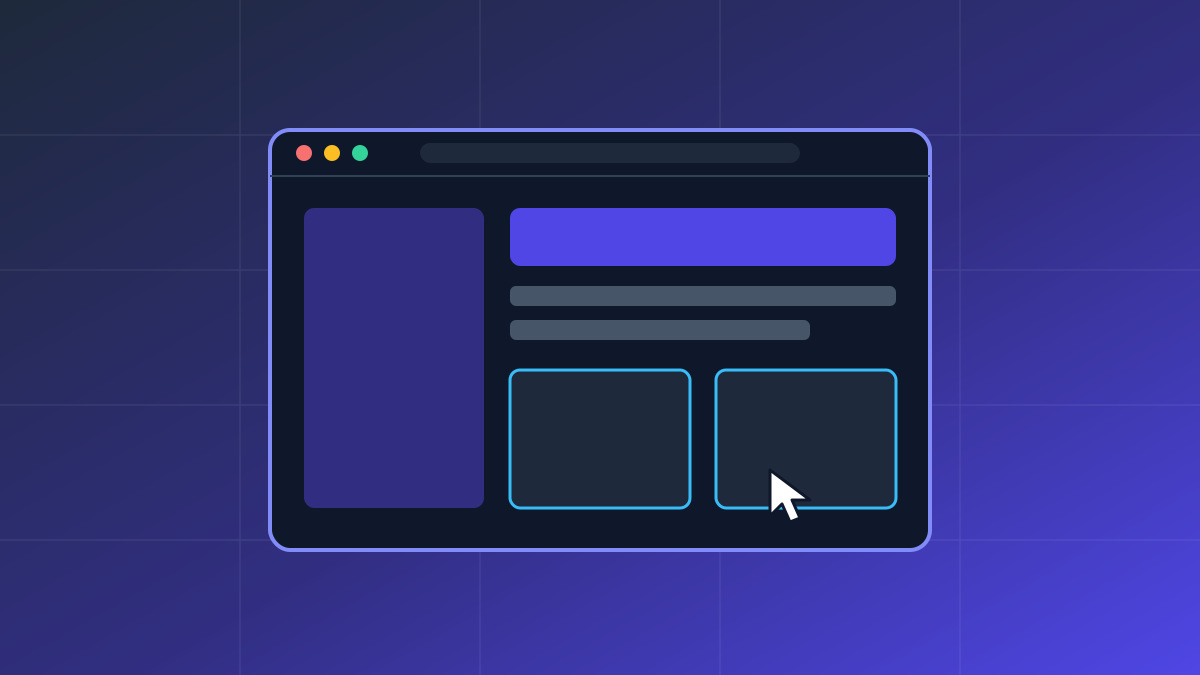
What makes a good landing page: one goal, a clear headline, real proof, a single CTA, less friction, and fast loading - plus a step-by-step guide to build one.
A good landing page is a single page built to drive one action from one audience, with everything on it pointing toward that action and nothing distracting from it. It has a clear headline that states the result, real proof, a single call to action, as little friction as possible, and it loads fast. That is the whole recipe. The hard part is the discipline to leave everything else off.
A landing page is different from your homepage. Your homepage is a lobby with doors to every room. A landing page is a hallway with one door at the end. People usually arrive on a landing page from an ad, an email, or a specific link, already half-interested, and the page has one job: convert that interest into action. When small business owners tell me their ads are not working, the problem is often not the ad, it is the page the ad sends people to. Below I will explain what separates a landing page that converts from one that leaks visitors, and then walk you through building one step by step.
What makes a good landing page convert
Six things do almost all the work. Miss any one and the page underperforms.
One goal, one audience
The biggest mistake is asking a single page to do several jobs. Sell a product, recruit staff, and explain the company history all at once, and it does none well. A good landing page picks one action and one type of visitor, then ruthlessly removes anything that does not serve them. A page with two goals effectively has zero.
A headline that states the result
The headline is the most important text on the page, because most visitors read it and nothing else before deciding whether to stay. It must say, in plain words, what the visitor gets and why it matters. "Get a fast, modern website in two weeks" works because it names the result and the timeframe. "Welcome to our digital journey" works on nobody. Lead with the outcome, not with yourself.
Proof that you deliver
A visitor's silent question is "can I trust this?" You answer it with proof, not adjectives. Genuine testimonials, recognizable client logos, real numbers, before-and-after results, and a photo of a real human all carry far more weight than you insisting you are great. Put proof high on the page, not buried at the bottom where nervous visitors never reach.
A single, clear call to action
The call to action is the button that drives your one goal. It should use action words that describe what happens, like "Book your free call," never a flat "Submit." On a longer page, repeat the same button so people can act the instant they are convinced. Crucially, do not offer competing actions. Every extra link is an exit.
As little friction as possible
Friction is anything that makes saying yes harder. A navigation menu that lets people wander off, a form asking for ten fields when you need two, jargon that confuses, an obvious objection you never address. Each one bleeds visitors. A good landing page is stripped to only what helps someone decide, and it answers the main worry before they have to ask.
Speed
None of the above matters if the page is slow. Visitors judge load time in the first second, and a sluggish page loses people before they read your brilliant headline. Compressed images, minimal scripts, and a sub-two-second load are not luxuries; they are the price of entry. This connects to the broader picture of what makes a website convert, which goes beyond landing pages to your whole site.
The anatomy of a high-converting landing page
Here is the typical structure I use, top to bottom.
| Section | Its job |
|---|---|
| Headline + subheadline | State the result and who it is for in seconds |
| Primary call to action | Offer the one action, high on the page |
| Proof (testimonials, logos, numbers) | Answer 'can I trust this?' |
| Benefits, not features | Explain what the visitor gains |
| Objection handling | Defuse the main reason to hesitate |
| Repeated call to action | Let people act the moment they decide |
Notice what is missing: a big navigation menu, links to unrelated pages, a wall of company history, and five competing buttons. A landing page is defined as much by what you leave out as by what you put in.
How to build a good landing page step by step
Here is the order I actually work in, and it is deliberately not "open a design tool and start." The thinking comes first.
1. Pick one goal and one audience. Write down the single action and the single visitor in one sentence. This decision shapes every other choice and prevents the page from sprawling.
2. Write the headline first. Before any design, nail the one line that states the result. If you cannot write a clear headline, the offer itself may need sharpening, and it is better to learn that now.
3. Gather your proof. Collect your best testimonials, results, and logos. If you have little proof yet, even one honest quote and a real photo beats a page of empty claims.
4. Write the one call to action. Decide the exact button text and what happens when it is clicked. Keep any form to the fewest fields you can live with.
5. Strip out friction. Remove the menu, cut every link that is not the call to action, delete jargon, and answer the main objection. Read the page as a skeptical stranger.
6. Make it fast and mobile. Compress images, remove heavy scripts, and test on a real phone until it loads quickly and works one-handed.
That sequence, thinking before designing, is exactly why a plain page built in the right order routinely beats a beautiful page built in the wrong one.
The most common landing page mistakes
A few traps catch nearly everyone. Sending paid traffic to your homepage instead of a focused page, so the visitor lands in a lobby with no clear next step. Burying the call to action below a long story. Asking for too much information in the form. Talking about yourself instead of the visitor's result. And leaving the main navigation in place so people wander off and never come back. If your page gets clicks but no conversions, the leak is almost always one of these, and I cover the broader version in why you get traffic but no leads.
Build the page around the one action
The whole skill of a good landing page is subtraction. You start with the one action you want, then remove everything that does not push toward it until what remains is a clear, fast, trustworthy path to a single yes. Most pages fail not because they are missing something, but because they include too much. When in doubt, cut.
I design and build landing pages that are structured around a single action and tested to load fast on a phone. If your ads or emails are sending people to a page that is not converting, book a quick call and I will tell you where it is leaking. You can also reach me through the contact form. For the principles behind the look of the page, my guide to web design principles for small business is a useful companion read.
Frequently asked questions
What makes a landing page convert well?
Six things do most of the work: one goal and one audience, a headline that states the result, real proof like testimonials and logos, a single clear call to action, as little friction as possible, and fast loading. Miss any one and the page underperforms. The discipline is leaving everything else off.
What is the difference between a landing page and a homepage?
A homepage is a lobby with doors to every room, made to help visitors explore. A landing page is a hallway with one door at the end, built to drive a single action from people who usually arrive from an ad, email, or specific link. Sending paid traffic to a homepage instead of a focused landing page is a common, costly mistake.
How long should a landing page be?
As long as it needs to be to make one convincing case, and no longer. A simple, low-risk offer can convert on a short page; a higher-priced or complex offer usually needs more proof and objection handling. Whatever the length, keep one goal, repeat the single call to action, and cut anything that does not push toward it.
Why should a landing page have only one call to action?
Because every competing option splits attention and many visitors then choose none. A landing page exists to drive one action, so the same call to action should be repeated and nothing should compete with it. Leaving the main navigation in place is a common leak, since it lets people wander off and never come back.
Why is my landing page getting clicks but no conversions?
Usually one of a few leaks: the headline does not state a clear result, the call to action is buried or competing with other links, the form asks for too much, there is no proof to build trust, or the page loads slowly. Fix those in order and conversions typically improve without needing more traffic.
Keep reading
Related service
Web Development
Fast, custom websites and web apps you fully own.
About the author
Yehonatan Saadia
Freelance automation, web & MVP developer
I'm Yehonatan Saadia, a senior developer who builds business automation, custom websites, and MVPs for small and mid-sized companies across the US, Europe, and Israel. These guides come from real client work, not theory.
Work with meHave a project like this?
Tell me what you're trying to automate or build and I'll tell you the fastest reliable way to ship it.