
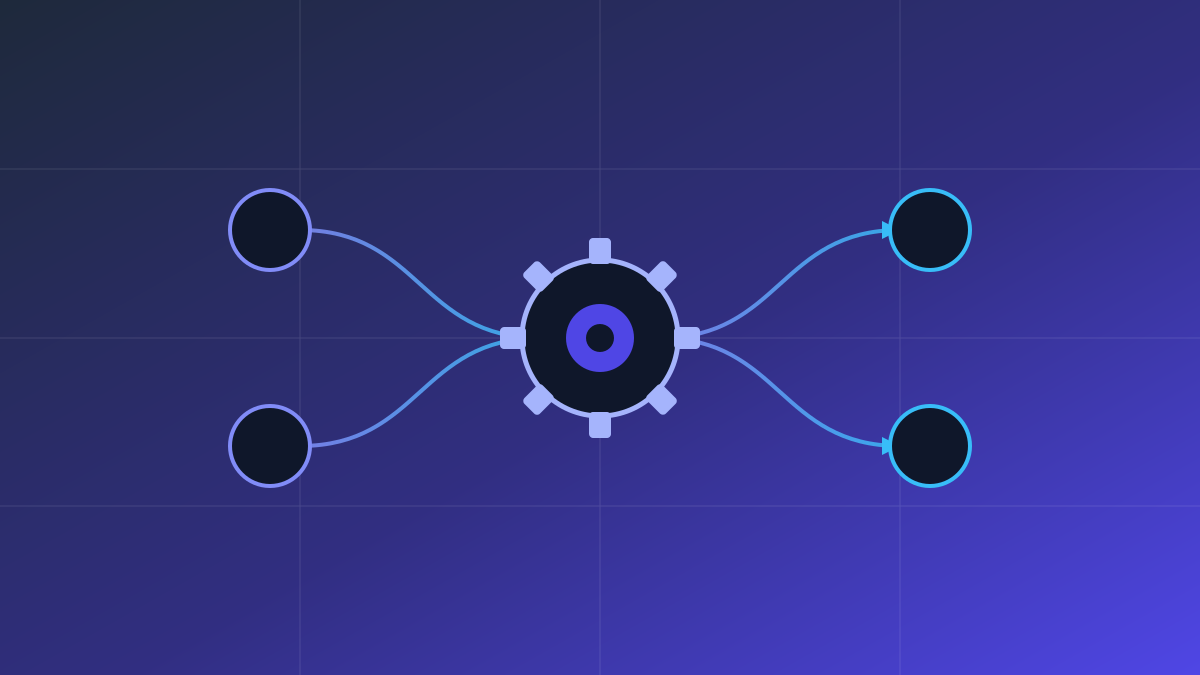
What is a data pipeline? A plain-English guide: what it is, how moving and transforming data works, what ETL means, real business examples, and when your business needs one.
A data pipeline is an automated system that moves data from where it is created to where it is needed, cleaning and reshaping it along the way so it arrives ready to use. Picture water plumbing: data enters at one end (your store, your forms, your accounting app), flows through a series of steps that filter and tidy it, and comes out the other end in a clean, combined form you can actually report on or act on. The whole point is that this happens on its own, on a schedule or in real time, instead of someone exporting spreadsheets and copy-pasting by hand every week.
In this guide I will define what a data pipeline really is, explain in plain terms how moving and transforming data works, demystify the term ETL, give real business examples, and help you judge when your business actually needs one.
What is a data pipeline, in plain English
Most businesses have data scattered across many tools: sales in one app, marketing in another, payments in a third, support in a fourth. Each tool sees only its own slice. A data pipeline is the plumbing that connects them - it pulls data out of each tool, reconciles it so the same customer is recognized everywhere, and delivers a single, combined view to one place (a dashboard, a report, or a central database).
The key word is automated. Without a pipeline, getting a complete picture means a person logging into five tools, exporting five spreadsheets, fixing mismatched formats, and stitching them together - every time they want an answer. A data pipeline does that work continuously and silently, so the up-to-date answer is always waiting. It is one of the most practical forms of workflow automation, focused specifically on data.
The three jobs a data pipeline does
Almost every pipeline does three things in order. This is the whole concept, and it is simpler than it sounds.
- Extract - get the data out. The pipeline collects data from your sources: a Shopify store, a payment processor, a CRM, a spreadsheet, an API from some other service. It pulls a copy without you touching anything.
- Transform - clean and reshape it. Raw data is messy. The pipeline fixes inconsistent dates, merges duplicate customers, converts currencies, removes junk, and combines fields so everything speaks the same language. This is where the real value is created.
- Load - put it where it is needed. The clean, combined data lands in its destination: a reporting dashboard, a data warehouse, another app, or a simple shared sheet your team trusts.
Extract, transform, load - that is where the term ETL comes from, the three letters you will hear thrown around. There is also ELT (load first, transform later), but you do not need to care about the order; the jobs are the same. When someone says "we need an ETL pipeline," they mean exactly this: a system that gets data out, cleans it, and delivers it somewhere useful.
Why a business owner should care
This sounds technical, but the business case is plain. Here is what a data pipeline actually buys you.
| Without a pipeline | With a pipeline |
|---|---|
| Hours each week exporting and merging spreadsheets | Reports update themselves automatically |
| Numbers disagree between tools, nobody trusts the data | One reconciled source everyone trusts |
| Decisions made on last month's stale figures | Decisions made on today's numbers |
| A person re-keys data and makes typos | Consistent, error-free transfers |
The two biggest wins are time and trust. The time spent manually pulling and merging data is pure overhead that scales badly - the more tools and the more data, the worse it gets. And manual handling introduces errors, which quietly erode confidence in your own reports. A pipeline removes both problems at once: the work happens automatically, and it happens the same correct way every time.
Real data pipeline examples for business
Concrete cases make this land. Here is what data pipelines realistically do for small and mid-sized businesses.
- One unified sales dashboard. A pipeline pulls orders from your store, ad spend from your marketing platforms, and costs from your accounting tool, then combines them so you see true profit per channel - automatically, every morning.
- Syncing customers between tools. A new customer in your store is automatically created in your CRM and your email tool, with no duplicates and no manual entry, so every system stays in step.
- Nightly reporting. Every night the pipeline gathers the day's numbers from all sources, cleans them, and refreshes the report waiting on your desk - no Monday-morning spreadsheet ritual.
- Moving data into a warehouse. As a business grows, a pipeline feeds all its data into one central store so analysts (or an AI tool) can ask questions across everything at once.
- Feeding clean data to other systems. A pipeline can prepare and deliver data into a vector database or a knowledge base so an AI assistant always works from current, accurate information.
Notice the pattern: any time data lives in more than one place and someone has to move or reconcile it by hand, a pipeline can take over that job.
When does your business need a data pipeline?
Here is the honest test I use with clients. You probably need one when several of these are true:
- You manually export and merge data regularly. If someone spends hours each week pulling spreadsheets together, a pipeline pays for itself fast - this is the clearest signal.
- Your numbers disagree between tools. When sales reports do not match accounting, you have a reconciliation problem a pipeline is built to solve.
- You make decisions on stale data. If your reports are always days or weeks behind because updating them is painful, automation gives you current numbers continuously.
- You are adding tools faster than you can connect them. Each new app makes manual stitching worse. A pipeline scales where copy-paste does not.
The flip side: if all your data already lives in one tool, or you genuinely look at it once a quarter, a formal pipeline is overkill. Start by counting the hours your team spends moving data by hand each month - that number tells you most of what you need to know. If you want a sense of what building this kind of automation costs, my guide to how much business automation costs breaks it down honestly.
Related terms worth knowing
A few words travel alongside data pipelines. ETL / ELT are just the extract-transform-load steps described above. An API is the connector a pipeline uses to pull data out of an app - see what is an API. A data warehouse is the central destination where a pipeline often loads everything for analysis. And a pipeline is itself a specialized kind of workflow automation - the broader practice of letting software do repetitive work so your team does not have to.
If you are spending real hours moving data between tools, or your reports never quite agree, book a call and walk me through your setup. I will tell you honestly whether a data pipeline would pay off and roughly what it would take to build. You can also reach me through the contact form.
Frequently asked questions
What is a data pipeline in simple terms?
A data pipeline is an automated system that moves data from where it is created to where it is needed, cleaning and reshaping it along the way. Like plumbing, data enters from your tools, flows through steps that filter and tidy it, and comes out combined and ready to report on - all on its own, instead of someone exporting and merging spreadsheets by hand.
What does ETL mean?
ETL stands for Extract, Transform, Load - the three jobs a data pipeline does. Extract gets data out of your tools, Transform cleans and reshapes it, and Load delivers it to a dashboard, warehouse, or another app. ELT is the same jobs in a different order (load first, transform later); for most owners the distinction does not matter.
What is the difference between a data pipeline and an API?
An API is the connector that lets one app share its data with another. A data pipeline is the larger system that uses APIs to pull data out, then cleans, combines, and delivers it somewhere useful. Put simply, the API is one doorway; the pipeline is the full delivery route that uses many doorways and processes what passes through.
Do I need a data pipeline for a small business?
You probably do if someone regularly exports and merges spreadsheets by hand, if your numbers disagree between tools, or if you make decisions on stale data. Count the hours your team spends moving data manually each month - if it is significant, a pipeline pays for itself. If all your data lives in one tool, a pipeline is overkill.
What are the main benefits of a data pipeline?
The two biggest are time and trust. It eliminates the hours spent manually pulling and merging data, and it removes the human errors that quietly erode confidence in your reports. The result is reports that update themselves, one reconciled source everyone believes, and decisions made on today's numbers instead of last month's stale figures.
Keep reading
Related service
Web Scraping
Reliable web scraping and data pipelines that deliver clean data.
About the author
Yehonatan Saadia
Freelance automation, web & MVP developer
I'm Yehonatan Saadia, a senior developer who builds business automation, custom websites, and MVPs for small and mid-sized companies across the US, Europe, and Israel. These guides come from real client work, not theory.
Work with meHave a project like this?
Tell me what you're trying to automate or build and I'll tell you the fastest reliable way to ship it.