
What is agentic AI? A plain-English guide: how AI that plans and takes multi-step actions differs from a chatbot, real business examples, the limits, and the oversight it needs.
Agentic AI is software that takes a goal you give it, plans the steps needed to reach it, and then carries those steps out on its own - using tools, calling other systems, and adjusting along the way. The key word is agentic: it acts. A normal chatbot answers a question and stops; an agentic system keeps going until the job is done or it decides it cannot finish. Think of it less like a search box and more like handing a task to a capable assistant and trusting them to work through it.
This is the phrase the whole industry is using in 2026, often loosely and often with too much hype. So in this guide I will define agentic AI in plain terms, show how it differs from a regular chatbot, walk through what it can realistically do for a business, be honest about where it falls short, and explain the oversight it genuinely needs before you let it loose.
What is agentic AI, in plain English
Most software follows a fixed script: do step one, then step two, then step three. You wrote those steps in advance and the program just replays them. Agentic AI flips that. You give it a goal instead of a script, and the system works out the steps itself. You say "chase up every unpaid invoice from last month," and it figures out which invoices are overdue, drafts a reminder for each, and sends them - without you spelling out each move.
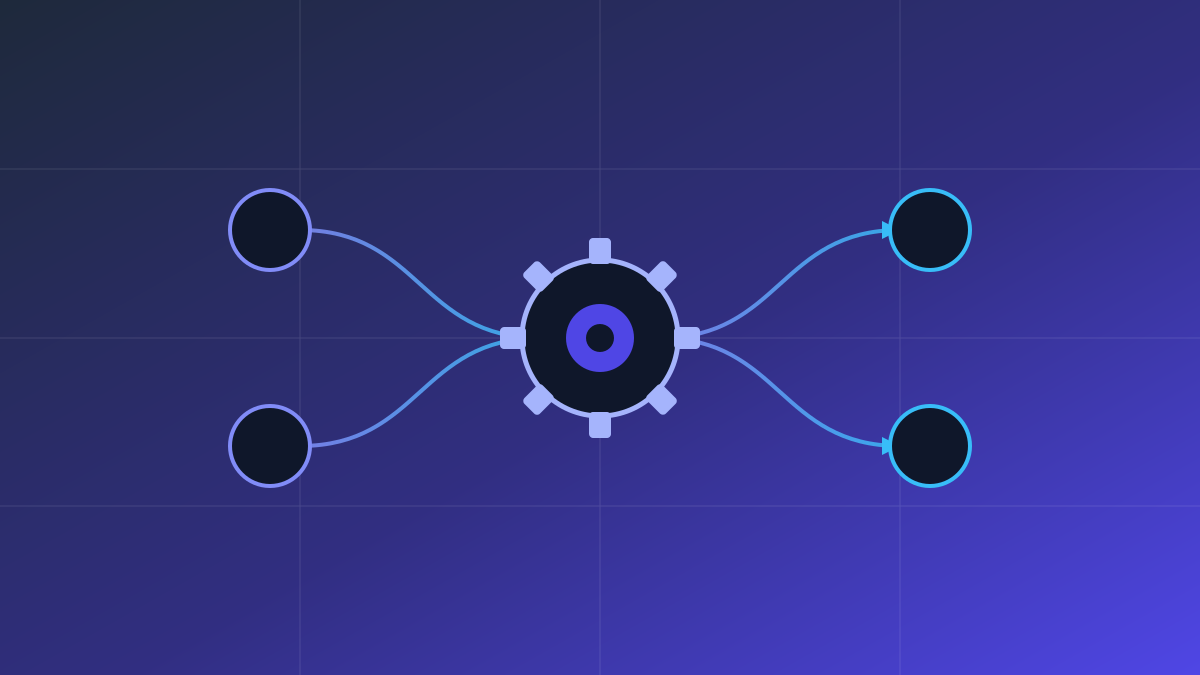
The simplest way to picture it: an agentic system is a reasoning model (the thinking part) connected to a set of tools it is allowed to use (your email, your CRM, a spreadsheet, a database) wrapped in a loop that lets it keep working until the goal is met. The model decides what to do next, the tools let it actually do it, and the loop lets it react when something does not go as planned. If you want the deeper mechanics of the underlying building block, my guide to what an AI agent is breaks down the perceive-decide-act cycle step by step.
Agentic AI vs a chatbot
People mix these up constantly, and the difference is the whole point. A chatbot is a conversation. Agentic AI is an employee who can be sent off to do something.
| Capability | Chatbot | Agentic AI |
|---|---|---|
| Answers a question | Yes | Yes |
| Plans a multi-step task | No | Yes |
| Uses tools (email, CRM, database) | No | Yes |
| Takes real action on its own | No | Yes |
| Reacts when a step fails | No | Yes |
A chatbot can tell you how to issue a refund. Agentic AI checks the order, applies your refund policy, issues the refund, and emails the customer - then confirms it worked. The line is simple: a chatbot talks, an agentic system does. That ability to plan and act is also why it is more powerful and, honestly, riskier, which is why the oversight section below matters as much as the capability.
What can agentic AI actually do for a business?
Hype aside, here is what agentic AI realistically does for small and mid-sized businesses today. Notice the pattern: every strong use case mixes a clear goal with messy, variable inputs that a rigid script cannot handle.
- End-to-end support handling. It reads an incoming ticket, looks up the customer's order and history, resolves straightforward issues completely, and escalates the genuinely hard ones to a person with a written summary attached.
- Lead research and outreach prep. Given a list of prospects, it visits each company site, pulls the relevant details, scores the fit against your criteria, and drafts a tailored first message for your review.
- Invoice and payment chasing. It identifies overdue invoices, drafts reminders matched to how late each one is, sends them, and flags the ones that need a human call.
- Report generation. It pulls numbers from several systems, spots what changed, writes a plain summary, and emails it to you on a schedule.
- Data cleanup and entry. It reads messy emails or PDFs, extracts the order or invoice details, and enters them into your system correctly - the kind of judgment a fixed rule chokes on.
What these share is a goal plus variability. For the purely predictable parts of any of these flows, plain automation is cheaper and steadier. The strongest systems I build use ordinary automation for the predictable steps and reserve the agentic part for the one or two steps that genuinely need judgment. My piece on AI vs automation for business walks through exactly where that line sits.
The limits you need to know
I would be doing you a disservice if I let the hype stand unchallenged. Agentic AI is genuinely useful, but it has real limits, and ignoring them is how projects fail.
- It can be confidently wrong. The reasoning model makes mistakes and states them with total confidence. Anything with real consequences needs guardrails and, often, a human check.
- It can drift off course. Because it plans its own steps, a long task can wander or misread its progress. Clear goals and tight scope keep it on track.
- It needs firm boundaries. An agent with broad permissions and no limits is a liability. You define exactly which tools it may touch and what it can do without approval.
- It costs more to run. Each planning step calls a model, so a chatty agent doing many steps costs more per task than a fixed automation. At high volume that adds up.
- It is harder to make reliable. Deciding at runtime means it is less predictable than a fixed flow. Getting one production-ready takes testing, monitoring, and clear fallbacks.
The honest framing: agentic AI is a capable junior employee, not a flawless robot. You give it clear instructions, limited authority, and a way to escalate - and you check its work until it has earned trust.
The oversight agentic AI needs
Because an agentic system takes real action, the design question is not just "can it do the task" but "what happens when it gets the task wrong." Good oversight is what separates a useful agent from a dangerous one. Here is the setup I use.
- Least privilege. Give it access only to the tools and data the task actually requires, nothing more. A support agent does not need your billing admin rights.
- A human in the loop for consequential actions. Sending a draft, flagging for approval, or pausing before anything irreversible. The agent prepares, a person approves.
- A clear audit trail. Log every action it takes so you can see what happened and why. When something goes wrong, you need to trace it.
- Hard limits and a kill switch. Spending caps, rate limits, and an easy way to stop it. Plan for the bad day before it arrives.
Start narrow: pick one task where a mistake is cheap to undo or where a human reviews the output, run it under supervision, and widen the agent's authority only as it earns trust. The businesses that succeed with agentic AI treat it like onboarding a new hire, not flipping a switch.
So is agentic AI worth it for you?
Agentic AI is worth it when a task genuinely needs judgment a fixed rule cannot express, the inputs are messy or variable, and a mistake is recoverable or checkable. If your task is predictable and you can write it as if-this-then-that, plain automation is cheaper and more reliable - do not reach for an agent just because it is the trend. Most businesses need more ordinary automation than they think and fewer agents than the hype suggests.
If you are weighing whether agentic AI fits a problem in your business, book a call and describe the task. I will tell you honestly whether an agentic system, plain automation, or a blend of the two is the right answer - and roughly what each would take to build and run. You can also reach me through the contact form, or read my guide to business automation for small business to see where the simpler, cheaper path often wins.
Frequently asked questions
What is agentic AI in simple terms?
Agentic AI is software you give a goal to, and it plans the steps and acts on its own to reach it, using tools like your email, CRM, or a database. Unlike a chatbot that only answers, an agentic system actually does the work - it decides what to do next, takes action, reacts when a step fails, and loops until the goal is met.
What is the difference between agentic AI and a chatbot?
A chatbot is a conversation - it answers questions but does not take action. Agentic AI plans a multi-step task, uses tools to do the work, takes real action on its own, and reacts when a step fails. A chatbot can tell you how to issue a refund; agentic AI checks the order, issues the refund, and emails the customer.
What can agentic AI actually do for a business?
Realistic uses include end-to-end support handling that escalates hard cases, lead research and outreach prep, chasing overdue invoices, generating reports from several systems, and cleaning up data from messy emails or PDFs. The strongest setups pair agentic AI for the steps that need judgment with plain automation for the predictable parts.
What oversight does agentic AI need?
Because it takes real action, give it least privilege (only the tools and data the task needs), a human in the loop for consequential or irreversible actions, a clear audit trail of every action, and hard limits plus a kill switch. Start narrow with a task where mistakes are cheap to undo, and widen its authority only as it earns trust.
Do I need agentic AI or just plain automation?
If your task is predictable and you can write it as if-this-then-that rules, plain automation is cheaper, faster, and more reliable. Agentic AI is worth it only when the task needs real judgment, the inputs are messy or variable, and a mistake is checkable or recoverable. Most businesses need more automation and fewer agents than the hype suggests.
Keep reading
Related service
AI Agents
Custom AI agents and chatbots wired into your real business tools.
About the author
Yehonatan Saadia
Freelance automation, web & MVP developer
I'm Yehonatan Saadia, a senior developer who builds business automation, custom websites, and MVPs for small and mid-sized companies across the US, Europe, and Israel. These guides come from real client work, not theory.
Work with meHave a project like this?
Tell me what you're trying to automate or build and I'll tell you the fastest reliable way to ship it.