
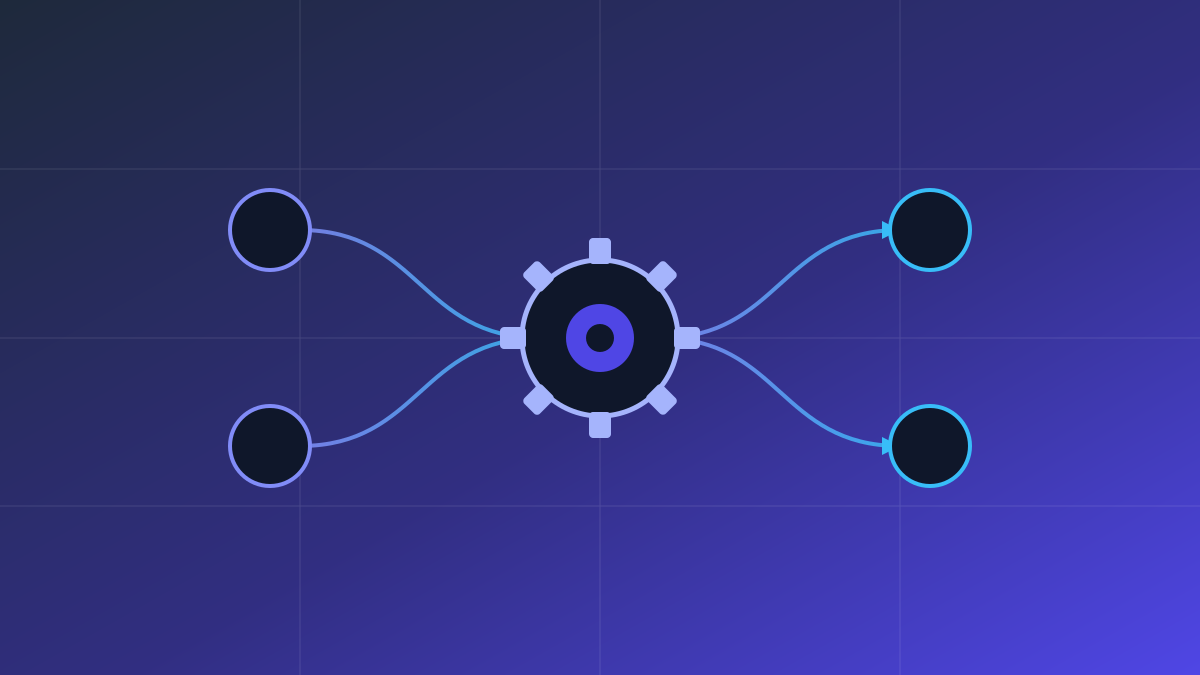
What is MCP? A plain-English guide to the Model Context Protocol: the open standard that lets AI assistants connect to your tools and data through one common interface, why it matters, and where it stands in 2026.
MCP, the Model Context Protocol, is an open standard that lets AI assistants connect to your tools and data through one common interface. Instead of every AI app needing a custom-built bridge to every system - your calendar, your database, your files, your CRM - MCP defines a single shared way for them to talk. The easiest analogy is a USB-C port for AI: one standard plug that any tool can expose and any AI assistant can use, so things just connect.
This is one of the more important shifts in how AI gets useful for real work, and it is moving fast. In this guide I will explain what MCP actually is in plain terms, why a connection standard matters so much, what it unlocks, where the technology honestly stands in 2026, and what it means for a business owner who is not going to read a technical spec.
The problem MCP solves
An AI assistant on its own can only talk. To be genuinely useful for work, it needs to reach into your actual systems - read a document, check a calendar, pull a record from a database, update a spreadsheet. The catch is that every one of those systems speaks its own language and exposes its data differently.
Before MCP, connecting an AI to each tool meant building a custom integration for every single pairing. If you had four AI apps and ten tools, that was potentially forty bespoke bridges to build and maintain. It was the same messy, expensive problem that connectors and standards have solved in other parts of technology before. If the idea of systems talking to each other through a defined interface is new to you, my guide on what an API is sets the foundation that MCP builds on.
MCP cuts through that. A tool exposes its capabilities once, in the MCP standard. Any AI assistant that speaks MCP can then use it - no custom bridge per pairing. Build it once, connect it everywhere.
What is MCP, in plain English
Think of MCP as a universal adapter sitting between the AI and your tools. It defines three simple things the AI can work with:
| MCP concept | What it means | Everyday example |
|---|---|---|
| Tools | Actions the AI can take | Send an email, create a calendar event, update a row |
| Resources | Data the AI can read | A document, a database record, a file |
| Prompts | Reusable instructions a tool offers | A ready-made way to summarize a report |
The setup has two sides. An MCP server wraps one of your tools or data sources and exposes it in the standard. An MCP client - the AI assistant - connects to that server and uses what it offers. Because both sides speak the same protocol, any compliant assistant can use any compliant server. That is the whole point: a common interface that ends the per-tool custom work.
Why a standard like MCP matters
It is easy to underrate a standard because it sounds boring. But standards are exactly what turn a promising technology into a practical one. Here is why MCP matters.
- It makes AI actually act, not just chat. The leap from an assistant that answers questions to one that does work depends entirely on it reaching your tools. MCP is the plumbing that makes that reach standard and reliable. This is the same leap I describe in my guide to what an AI agent is.
- It avoids lock-in. Because MCP is an open standard rather than one company's private format, a tool you connect today is not chained to a single AI vendor. You can switch assistants without rebuilding all your integrations.
- It compounds. Every tool that adds MCP support becomes instantly usable by every MCP-speaking assistant. The ecosystem grows for everyone at once, which is how a standard gains momentum.
- It lowers the cost of useful AI. Less custom integration work means connecting AI to your real systems gets cheaper and faster, which is what brings it within reach of a normal business rather than only big enterprises.
What MCP unlocks
Once an AI can reliably reach your tools through a standard, the practical possibilities change. Here is what that enables in concrete terms:
- AI that works inside your systems. An assistant that can read your real calendar, check your real inventory, and draft against your real documents - not generic answers, but ones grounded in your actual business data.
- Assistants that take action. Beyond reading, an MCP-connected assistant can create the calendar event, send the email, or update the record, with the right permissions.
- Mixing and matching tools. Connect several MCP servers at once and the assistant can work across them in a single task - pull data from one system and write it into another.
- Reuse across assistants. A server you build for one AI app works with the next one, because they share the protocol.
This is the connective tissue underneath the kind of practical automation I build for clients. For the broader picture of how AI agents use connected tools to get work done, my guide to AI agents for business automation shows where this leads.
Where MCP honestly stands in 2026
I want to be straight about the current state, because hype is unhelpful. MCP is real and gaining ground fast, but it is still maturing.
- Adoption is growing quickly. Major AI assistants and a rising number of tools now support MCP, and the list of available servers expands constantly. It has clearly become the leading common standard for connecting AI to tools.
- It is still early in places. Some servers are polished, others are rough community efforts. Quality and coverage vary, and not every tool you want has a server yet.
- Security and permissions need care. Giving an AI the ability to act in your systems is powerful and therefore needs real guardrails: scoped permissions, careful approval of which servers you trust, and limits on what an assistant can do unsupervised.
- It is plumbing, not magic. MCP makes the connection standard. It does not, by itself, make the AI smart or safe. The value still depends on a well-built assistant and sensible boundaries around it.
The honest summary: MCP is the most promising answer so far to a real problem, it is being adopted broadly, and it is worth understanding now - while accepting that the ecosystem is still filling in and needs careful handling.
What MCP means for your business
You do not need to track the technical details. The practical takeaway is simpler. MCP is making it cheaper and more reliable to connect AI to the tools you already use, which means AI assistants that actually do work inside your business are moving from a custom, expensive project toward something far more accessible.
For most owners, the right move today is not to chase MCP for its own sake, but to know it exists and ask the right question: is there a task in my business where an AI that can read and act on my real data would save real time? Where the answer is yes, MCP is increasingly the standard way to build that connection well. I go deeper into the business angle, with concrete use cases, in my companion guide on MCP for business.
If you are curious whether an MCP-connected AI assistant could help with a specific task in your business, book a call and describe what you are trying to do. I will tell you honestly what is realistic today versus hype, and roughly what it would take. You can also reach me through the contact form.
Frequently asked questions
What is MCP (Model Context Protocol) in simple terms?
MCP is an open standard that lets AI assistants connect to your tools and data through one common interface. Instead of building a custom bridge between every AI app and every system, MCP defines a single shared way for them to talk - like a USB-C port for AI. A tool exposes its capabilities once, and any MCP-speaking assistant can use it.
What is the difference between MCP and an API?
An API is a defined interface for one specific system to expose its data and actions, and every API is different. MCP is a standard that sits on top of that idea: it gives AI assistants one consistent way to use many different tools, so an assistant does not need a custom integration per tool. Think of MCP as a common adapter built for AI, often wrapping existing APIs underneath.
Why does MCP matter for AI?
MCP matters because it turns an AI from something that only chats into something that can act inside your real systems. By standardizing the connection, it avoids vendor lock-in, lets every MCP-enabled tool work with every MCP-speaking assistant, and lowers the cost of connecting AI to your data. That is what makes practical, action-taking AI accessible to normal businesses, not just large enterprises.
Is MCP ready to use in 2026?
Yes, with realistic expectations. MCP adoption is growing fast, major AI assistants support it, and the list of available servers expands constantly, making it the leading common standard. But it is still maturing: server quality varies, not every tool has a server yet, and giving AI the ability to act needs careful permissions and guardrails. It is real and worth using, but it is plumbing, not magic.
Do I need to understand MCP to use AI in my business?
No, you do not need the technical details. The practical takeaway is that MCP is making it cheaper and more reliable to connect AI to the tools you already use. The right question for an owner is simply whether there is a task where an AI that can read and act on your real data would save real time. Where the answer is yes, MCP is increasingly the standard way to build that connection.
Keep reading
Related service
Business Automation
I build custom automations that remove repetitive work end to end.
About the author
Yehonatan Saadia
Freelance automation, web & MVP developer
I'm Yehonatan Saadia, a senior developer who builds business automation, custom websites, and MVPs for small and mid-sized companies across the US, Europe, and Israel. These guides come from real client work, not theory.
Work with meHave a project like this?
Tell me what you're trying to automate or build and I'll tell you the fastest reliable way to ship it.