
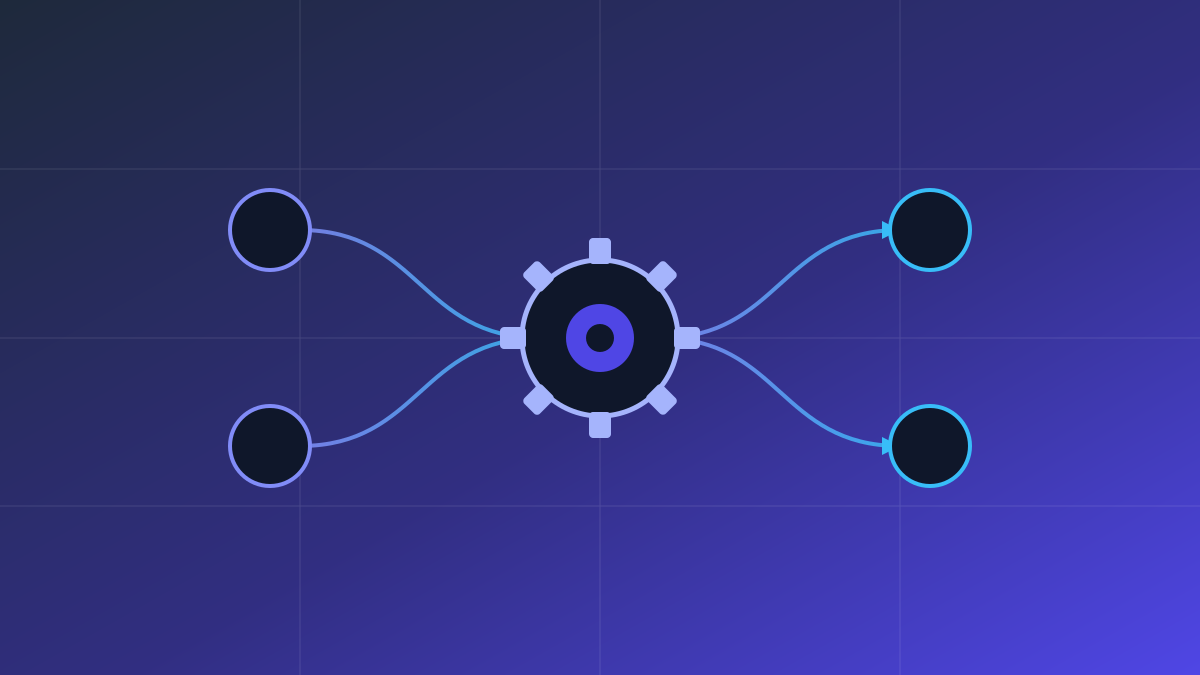
What is an MCP server? A plain-English guide: how the Model Context Protocol lets AI tools safely connect to your real systems, how it works, business examples, and when you need one.
An MCP server is a small piece of software that lets an AI tool safely connect to one of your real systems - your database, your CRM, your files, your calendar - and use it in a standard, predictable way. MCP stands for Model Context Protocol, an open standard that defines a common language for how an AI model asks to read data or take an action, and how your system answers. In plain terms: it is the universal adapter that lets AI assistants actually do things in your business instead of just talking about them.
This term started showing up everywhere in 2025 and is now part of everyday tooling in 2026. In this guide I will explain what an MCP server is without jargon, how the protocol works, why it matters for a business owner, real examples, and when you actually need one built. I will be honest about the limits too.
What is an MCP server, in plain English
Imagine every AI tool spoke a different language and every one of your systems had a different plug. Connecting them would mean a custom, brittle wire for every single pair. That is exactly the mess the world was in before MCP. The Model Context Protocol fixes it by agreeing on one shape for the conversation: any AI client that speaks MCP can talk to any MCP server, the same way any USB device fits any USB port.
An MCP server is the side that exposes a capability. You write (or install) a server that wraps your system and declares: "here are the things I can do - look up a customer, create an invoice, search these documents." The AI client (the assistant or agent) is the side that uses those capabilities. The protocol in the middle keeps the two cleanly separated so neither has to know the other's internal details.
If the idea of an AI that takes actions is new to you, my guide to what an AI agent is sets the stage - an MCP server is often what gives that agent its hands.
How an MCP server works
Under the surface, MCP is straightforward. A server offers three kinds of things to the AI client.
| Primitive | What it is | Example |
|---|---|---|
| Tools | Actions the AI can take | "Create a calendar event", "Issue a refund" |
| Resources | Data the AI can read | A customer record, a document, a price list |
| Prompts | Ready-made instructions for common tasks | "Draft a follow-up email for this lead" |
The flow is simple. The AI client connects to the server and asks what it offers. The server replies with its list of tools and resources. When the AI decides it needs to act - say, look up an order - it calls the matching tool through the protocol. The server does the real work against your actual system and returns the result. The AI reads the result and continues. Crucially, the server controls exactly what is exposed: the AI can only do what the server allows, nothing more.
This is closely related to a plain API, and if you already understand APIs you are most of the way there. The difference is that MCP is purpose-built for AI: it is self-describing, so the AI can discover what is available and how to use it, rather than a developer hard-wiring every call in advance.
Why an MCP server matters for your business
Here is the practical payoff. Without a way to connect, an AI assistant is a clever talker stuck behind glass - it can draft text but cannot touch your data or systems. An MCP server is the bridge that turns talk into action, safely.
- It unlocks real work. Once your CRM, your files, or your scheduling system is behind an MCP server, an AI assistant can actually look things up and make changes, not just describe them.
- It is reusable. Build one MCP server for your customer database and any MCP-speaking AI tool can use it - today's assistant and next year's. You are not locked into one vendor.
- It keeps you in control. The server is the gatekeeper. You decide which actions are exposed, what data is visible, and what requires a human's approval. The AI cannot reach past what you allow.
- It is becoming the standard. Because MCP is an open protocol that the major AI platforms have adopted, building to it means your integration keeps working as the tools around it evolve.
Real MCP server examples
Concrete cases make this land. Here is what businesses realistically connect through MCP servers today.
- CRM access. An MCP server over your CRM lets an assistant pull a lead's full history, log a call, or update a deal stage on command - without anyone clicking through screens.
- Document search. A server that exposes your internal documents so staff can ask a question in plain language and the AI finds and cites the right policy or contract.
- Scheduling. A server wrapping your calendar so the AI can check availability and book meetings against real, current data.
- Internal database. A read-only MCP server over a product or inventory database, so the AI can answer "how many of these are in stock?" accurately instead of guessing.
- Operations tools. A server that lets the AI trigger a defined action in your own software - generate a report, start a job, create a ticket - within strict limits you set.
Notice the pattern: each server exposes a tight, well-chosen set of capabilities. A good MCP server is narrow on purpose. It does not hand the AI the keys to everything; it hands over exactly the few actions that are useful and safe.
The limits you need to know
MCP is genuinely useful, but it is plumbing, not magic. A few honest caveats.
- It is a connector, not the intelligence. An MCP server just exposes capabilities. Whether they are used well depends on the AI client and on how clearly the tools are described.
- Security is on you. Because a server can grant an AI real power over your systems, it must be built carefully: least privilege, clear boundaries, and approval steps for anything risky. A sloppy server is a real liability.
- It still needs building. An off-the-shelf server exists for common systems, but connecting your specific, custom setup usually means someone writes the server and tests it properly.
- It does not fix bad data. If the system behind the server is messy, the AI gets messy answers. The connector cannot clean up what it connects to.
The right framing: an MCP server is a carefully built door between an AI and one of your systems. The value comes from choosing the right doors and locking them properly.
When do you need an MCP server?
You need one when you want an AI assistant or agent to do real work in a specific system of yours, repeatedly, in a way that ad-hoc copy-paste cannot cover. The signs are clear: you find yourself manually feeding the same data into an AI tool, or you want the AI to take actions in your CRM, calendar, or database rather than just advise.
You probably do not need a custom one yet if your AI use is purely conversational, or if a ready-made connector already covers your tool. And if the underlying task is fully predictable and rule-based, plain business automation may be the cheaper, more reliable answer - I help clients tell the two apart all the time.
If you want an AI assistant connected to your real systems and you are not sure whether an MCP server, a plain API, or simple automation is the right route, book a call and describe what you are trying to connect. I will tell you honestly what it would take and which approach fits. You can also reach me through the contact form.
Frequently asked questions
What is an MCP server in simple terms?
An MCP server is software that lets an AI tool safely connect to one of your systems - like your CRM, files, or calendar - using a shared standard called the Model Context Protocol. It declares exactly what the AI is allowed to read and do, acting as a controlled bridge so the AI can take real actions in your business instead of only talking.
What does MCP stand for?
MCP stands for Model Context Protocol. It is an open standard that defines a common language for how an AI model asks to read data or take an action, and how your system responds. Because it is a shared standard, any AI tool that speaks MCP can connect to any MCP server, the way any USB device fits any USB port.
What is the difference between an MCP server and an API?
Both expose a system's capabilities to other software, and MCP often sits on top of an API. The difference is that MCP is purpose-built for AI: it is self-describing, so an AI client can discover which tools and data are available and how to use them, instead of a developer hard-wiring every call in advance. An API is general-purpose; MCP is the AI-friendly standard layer.
Is an MCP server safe to connect to my business systems?
It can be safe when built carefully. The server is the gatekeeper - you decide exactly which actions are exposed, what data is visible, and what needs human approval. The AI cannot reach past what the server allows. The risk comes from a sloppy server with broad permissions, so a good one uses least privilege and clear boundaries.
Do I need a custom MCP server or just plain automation?
If you want an AI assistant to do real, repeated work in a specific system of yours, an MCP server is the bridge. But if the underlying task is fully predictable and rule-based, plain business automation is usually cheaper and more reliable. Many businesses need a mix - automation for the predictable steps and an MCP server only where AI judgment adds value.
Keep reading
Related service
Integrations
Make the systems you already pay for talk to each other.
About the author
Yehonatan Saadia
Freelance automation, web & MVP developer
I'm Yehonatan Saadia, a senior developer who builds business automation, custom websites, and MVPs for small and mid-sized companies across the US, Europe, and Israel. These guides come from real client work, not theory.
Work with meHave a project like this?
Tell me what you're trying to automate or build and I'll tell you the fastest reliable way to ship it.