
What is an AI workflow? A plain-English guide: how an AI step gets wired into an automated process (trigger to AI step to action), real business examples, the tools involved, how it differs from a one-off chat, and where it fits.
An AI workflow is an automated process where one or more AI steps are wired into a sequence that runs on its own: something triggers it, an AI step reads or decides or generates, and then an action happens as a result, with no person pressing buttons in between. The simplest shape is trigger, then AI step, then action. The whole point is that the AI is not sitting in a chat window waiting for you - it is plugged into your real systems and runs automatically whenever the trigger fires.
This is the difference between playing with ChatGPT and actually putting AI to work in a business. In this guide I will define what an AI workflow is in plain terms, show the basic shape with real examples, list the tools that wire it together, explain how it differs from a one-off chat, and tie it to the automation work I do day to day.
What is an AI workflow, in plain English
Think of a workflow as an assembly line: a series of steps that hand work from one station to the next without a human carrying the part between them. A plain automation workflow might be "when a form is submitted, add a row to a spreadsheet and send a confirmation email." Every step is a fixed rule, and it runs the same way every time.
An AI workflow is that same idea with at least one station replaced by an AI step - a point in the line where the system needs to understand, decide, or generate something a fixed rule cannot handle. The AI reads the messy input, produces an answer, and passes its result to the next station, which carries on with ordinary automation. The AI is one specialized worker on the line, not the whole factory.
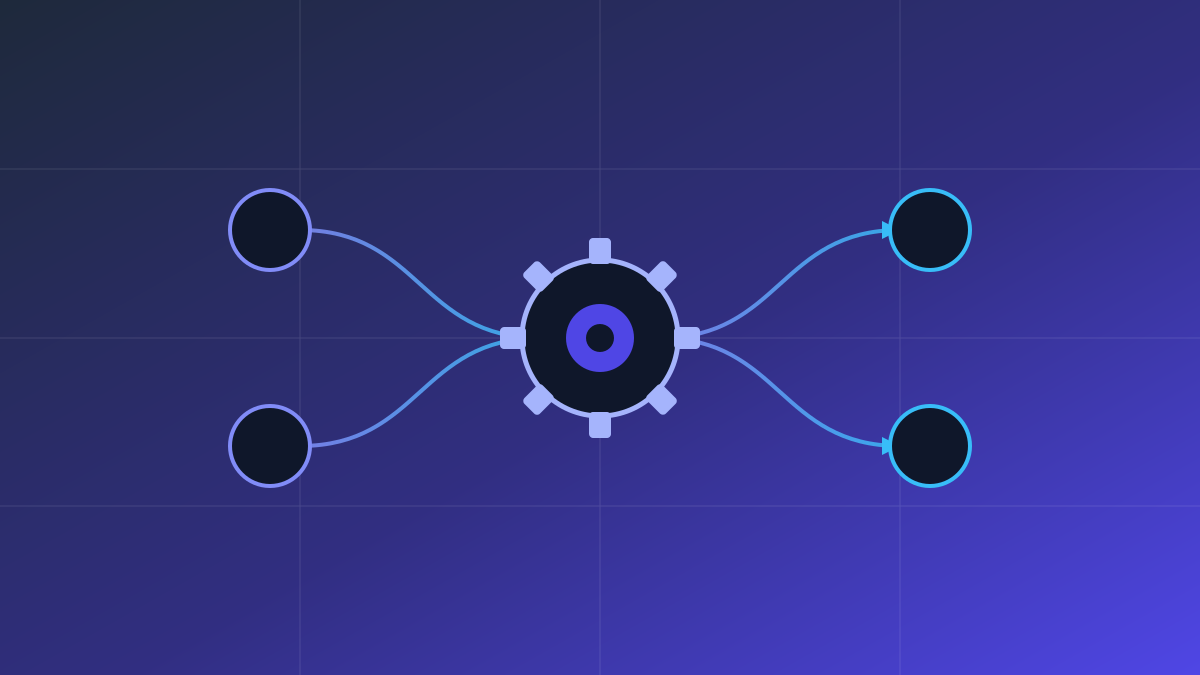
The basic shape is three parts:
- Trigger. Something kicks the workflow off - a new email arrives, a form is filled, a file is uploaded, a scheduled time hits, or a new row appears in a sheet.
- AI step. The system sends the relevant data to an AI model with an instruction: classify this, summarize that, extract these fields, draft a reply, decide which category this belongs to.
- Action. The workflow takes the AI's output and does something concrete with it - files it, routes it, updates a record, sends a message, creates a task.
Real workflows often chain several of these together, and the AI step might appear more than once, but trigger to AI step to action is the heartbeat of every one of them.
An AI workflow vs a one-off chat
This is the distinction that trips up most people. Chatting with an AI tool and running an AI workflow feel similar but are worlds apart in practice. The table below lays out why.
| Aspect | One-off chat | AI workflow |
|---|---|---|
| Who starts it | You, by typing | A trigger, automatically |
| How often | One conversation at a time | Every time the trigger fires |
| Where the input comes from | You paste or type it | Pulled from your systems |
| What happens to the output | You read it and act manually | Wired into an automatic action |
| Scales to volume | No, you are the bottleneck | Yes, runs unattended |
| Good for | Exploring, drafting, one-offs | Repeating tasks at scale |
A chat is brilliant for thinking something through or drafting a single thing. But if you find yourself copying the same kind of input into ChatGPT, getting a result, and pasting it somewhere else over and over, that is the signal that the task should be a workflow instead. The moment a chat becomes repetitive, you are doing by hand what a workflow would do automatically. My guide on when to stop doing it manually and automate it covers exactly how to spot that line.
Real AI workflow examples for business
Concrete examples make this click. Here are AI workflows I genuinely build for small and mid-sized businesses, each following the trigger, AI step, action shape.
- Inbound email triage. Trigger: a new support email lands. AI step: classify the topic and urgency and draft a suggested reply. Action: route it to the right person, create a ticket, and attach the draft for a human to approve.
- Invoice and document intake. Trigger: a supplier emails a PDF. AI step: read the document and extract the amount, date, vendor, and line items. Action: enter the structured data into your accounting tool and flag anything unusual.
- Lead enrichment. Trigger: a new lead fills your form. AI step: read the company website and summarize what they do and how well they fit. Action: write that summary into your CRM and notify sales.
- Content repurposing. Trigger: you publish a new article or record a call. AI step: summarize it and draft social posts and an email blurb. Action: drop the drafts into a review folder for you to polish and schedule.
- Internal knowledge answers. Trigger: a staff member asks a question in a chat channel. AI step: search your documents and compose an answer from them. Action: post the answer with a link to the source.
Notice the pattern in every one: the AI handles the messy, judgment-heavy middle, and ordinary automation handles the predictable plumbing around it. That split is the whole craft. For the deeper distinction between the rule-based parts and the AI parts, my guide to AI vs automation for business breaks it down, and if the AI step needs to know your own information, you will want the approach I describe in what RAG is.
The tools that wire an AI workflow together
You do not build most of these from scratch. The market has matured, and for the majority of business workflows you assemble existing pieces rather than writing everything in code. There are roughly three layers.
- The orchestrator is what connects the steps and moves data between them. Tools like Zapier and Make are the friendly, no-code end; n8n is a more flexible option that can self-host; and for complex or high-volume cases I write custom code. This layer is the assembly line itself. I walk through a concrete build in my tutorial on building an AI workflow with Zapier and ChatGPT.
- The AI model is the brain doing the understanding or generating at the AI step - typically a large language model accessed through an API. If you are fuzzy on what that means, my explainer on what an LLM is covers it.
- Your systems are the trigger sources and action targets: your email, CRM, spreadsheets, accounting software, chat tools, and databases. The workflow reads from some and writes to others.
Which combination is right depends on your volume, your budget, and how custom the logic is. A simple, low-volume workflow can live entirely in a no-code tool. A high-volume or intricate one usually earns custom code for reliability and cost control. Picking that correctly is most of what makes a workflow worth building.
When an AI step turns a workflow into an agent
One natural question: where is the line between an AI workflow and an AI agent? It is a matter of how much freedom the AI has. In a workflow, the path is mostly fixed - the AI does its specific job at its specific station, and the surrounding steps are predetermined. In an agent, the AI also decides which steps to take and in what order, looping and choosing tools as it goes.
For most business problems, a fixed AI workflow is the safer, cheaper, and more predictable choice, and it is what I reach for first. An agent is worth the extra complexity only when the task genuinely needs that runtime freedom. I lay out exactly where that line falls in my guide to what an AI agent is. The practical takeaway: start with a workflow, and graduate to an agent only when a fixed sequence truly cannot capture the task.
Where AI workflows fit in your business
The best candidates for an AI workflow share a profile. The task repeats often enough to be worth automating. It has a messy or unstructured step that a plain rule cannot handle, which is where the AI earns its place. And there is a clear action that should follow once the understanding is done. When those three line up, an AI workflow takes a task that used to eat your time in small daily chunks and runs it quietly in the background.
The honest caveat I always add: do not put AI in a workflow just because you can. If every step is predictable, a plain automation is cheaper and more reliable, and the AI adds cost and a margin of error for nothing. The skill is placing the AI only at the step that genuinely needs judgment, and letting deterministic automation handle everything else. That is how you get the upside without betting your operation on a tool that is right most of the time but not all of the time.
If you have a repetitive task that involves reading, deciding, or writing something and you suspect it could run on its own, book a call and walk me through it. I will tell you honestly whether an AI workflow fits, where the AI step should sit, and roughly what it would take to build. You can also reach me through the contact form, or read more about AI agents for business automation if you want the next step up.
Frequently asked questions
What is an AI workflow in simple terms?
An AI workflow is an automated process where one or more AI steps are wired into a sequence that runs on its own. The basic shape is a trigger that starts it, an AI step that reads, decides, or generates something, and an action that does something concrete with the result. Unlike chatting with an AI tool, the workflow is plugged into your real systems and runs automatically every time the trigger fires.
How is an AI workflow different from just using ChatGPT?
A chat is something you start by typing, one conversation at a time, where you read the output and act on it manually. An AI workflow is started by a trigger automatically, pulls its input from your systems, and wires the output into an automatic action. A chat is great for exploring or drafting a single thing; a workflow is for repeating the same kind of task at scale without you in the loop.
What tools do I need to build an AI workflow?
Usually three layers: an orchestrator that connects the steps and moves data (no-code tools like Zapier or Make, the more flexible n8n, or custom code), an AI model that does the understanding or generating at the AI step, and your own systems as the trigger sources and action targets, such as email, CRM, spreadsheets, and accounting software. Simple low-volume workflows can live entirely in a no-code tool.
What is the difference between an AI workflow and an AI agent?
It comes down to how much freedom the AI has. In a workflow the path is mostly fixed: the AI does its specific job at its specific step, and the surrounding steps are predetermined. In an agent, the AI also decides which steps to take and in what order, looping and choosing tools as it goes. For most business problems a fixed AI workflow is safer, cheaper, and more predictable, so start there and graduate to an agent only when a fixed sequence cannot capture the task.
When should a task become an AI workflow?
When three things line up: the task repeats often enough to be worth automating, it has a messy or unstructured step that a plain rule cannot handle (where the AI earns its place), and there is a clear action that should follow once the understanding is done. A good early signal is catching yourself copying the same kind of input into ChatGPT and pasting the result somewhere else over and over. If every step is predictable, use plain automation instead, since adding AI just adds cost and error.
Keep reading
Related service
Business Automation
I build custom automations that remove repetitive work end to end.
About the author
Yehonatan Saadia
Freelance automation, web & MVP developer
I'm Yehonatan Saadia, a senior developer who builds business automation, custom websites, and MVPs for small and mid-sized companies across the US, Europe, and Israel. These guides come from real client work, not theory.
Work with meHave a project like this?
Tell me what you're trying to automate or build and I'll tell you the fastest reliable way to ship it.